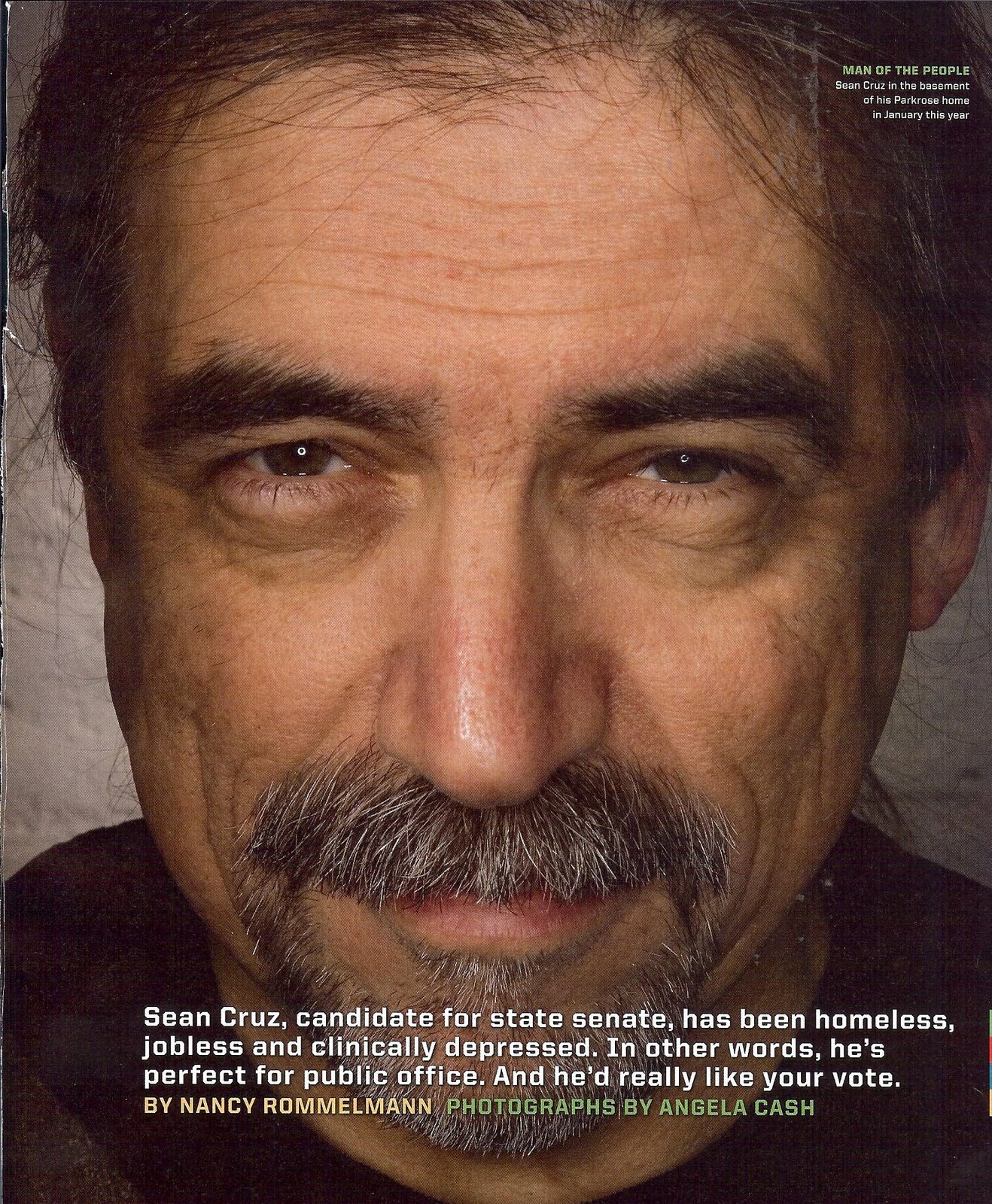
By Sean Cruz
Portland, Oregon—
Grief-stricken Mexican poet Javier Sicilia read a poem dedicated to his murdered son last Saturday, and then declared that this would be his last, that “Poetry does not exist in me anymore.”
I understand how he feels, find much in common, remember when the poetry died in my life…and how long it took to come back….
24-year-old Juan Francisco was found in an abandoned car along with six other bodies, their heads, faces, hands and feet bound with tape, suffocated to death under that tape, among the latest victims in the ongoing war that has its foundation in American demand for drugs and the many billions of dollars U.S. citizens are willing to export in order to feed their habits.
These seven are believed to be innocent, “collateral damage” in the incessant violence between the gangs, the cartels, for control of the smuggling routes, and the Mexican government, the battle for the soul of Mexico itself “so far from God, so close to the United States”….
More than 35,000 people have been murdered in Mexico in just the last five years, most often with guns supplied by U.S. gun dealers, and by criminal enterprises nearly entirely funded with U.S. dollars, smuggled back across the border or transferred electronically to offshore tax havens by corrupt American banking officials.
And now there is Mr. Sicilia’s last poem:
El mundo ya no es digno de la palabra
Nos la ahogaron adentro
Como te (asfixiaron),
Como te
desgarraron a ti los pulmones
Y el dolor no se me aparta
sólo queda un mundo
Por el silencio de los justos
Sólo por tu silencio y por mi silencio, Juanelo.
El mundo ya no es digno de la palabra, es mi último poema, no puedo escribir más poesía...la poesía ya no existe en mi.
The world is no longer worthy of the word
They suffocated it inside us
Like you (they asphyxiated)
Like you
they slashed your lungs
And pain won’t cleave from me
only a world is left
By the silence of the just
Only by your silence and by my silence, Juanelo.
The world is no longer worthy of the word—is my last poem, I can’t write any more poetry...poetry no longer exists in me. (Javier Sicilia)
I understand the grieving poet’s sentiments so well…nearly fifteen years went by following the loss of my children in a Mormon abduction…and more than five years passed after the death of my son Aaron, a death preventable had he received medical care of minimal competence…before I could find my way to the poetry, to the lyrics, to the music once again….
No one knows how long these things take….
No one knows how much time will pass before Mr. Sicilia finds the poetry in his soul once again….
A year ago, I would have been among the first to say, “Never…it will never exist in me again”….
But today I taste the bittersweetness of life with purpose and compassion…I hear songs, melodies, feel the pulse of the drumbeat in my heart…lyrics close to the surface, where tears used to abide…and down the road, perhaps, another poem will rise for Mr. Sicilia, as it has for me….
I greet the day gladly.
Thursday, May 05, 2011


Tuesday, April 26, 2011
Winona LaDuke releases new book: "The Militarization of Indian Country" on Earth Day
I am grateful for the opportunity to co-author The Militarization of Indian Country with Winona. This article appeared in Indian Country Today:
DENVER—Praising a draft United Nations treaty that would confer protections for Mother Earth, noted activist Winona LaDuke, White Earth Band of Ojibwe, also gave an Earth Day plug for indigenous sustainability and “creating something that is post-empire.”
The American Indian activist and author spoke at the University of Colorado Denver for an early commemoration of Earth Day 2011, whose theme this year is A Billion Acts of Green, “our people-powered campaign to generate a billion acts of environmental service and advocacy before Rio +20,” according to the site.
For her part, LaDuke drew attention to some decidedly un-green practices, pointing out that the American economy consumes from a fourth to a third of the world’s resources but that there is “a vast amount of waste” in the petroleum economy that distorts the oft-repeated argument that renewable energy can’t keep up with demand.
“But why try?” LaDuke queried, adding that “empire is inefficient.” She pointed out that 90 percent of energy from the common lightbulb is in the form of heat and only 10 percent is light. “It’s a false argument that we can’t meet demand without buttressing an inefficient system.”
Food security is a problem when food travels an average of 1,546 miles from producer to dinner table, the price of gas goes up and food cultivation may require 15 times more energy to produce than is consumed, she said.
Although she does not hate the military and believes veterans should be treated with honor and dignity, LaDuke does “despise militarization because those who are most likely to be impacted or killed by the military are civilian non-combatants” and because toxins and chemicals have severely impacted Indian lands, she said in the preface of a book she has co-written with Sean Cruz, The Militarization of Indian Country, put out by Honor the Earth, an organization that works internationally on issues of environmental justice and sustainability. She is the group’s executive director.
The two-time vice presidential candidate on the Green Party ticket also said she is considering another run for office—this time for tribal council on the White Earth reservation in northern Minnesota, a move that would be compatible with her belief that change is local—and probably inevitable.
“I’m proud of the casino economy, but if you can’t feed yourself, I don’t know if you can be sovereign again,” said LaDuke.
LaDuke said a study on her reservation showed that 14 percent of spending for food was on-reservation, primarily at convenience stores, but 86 per cent went off-reservation to big-box markets or other food sources; because half of total spending goes outside reservation boundaries, the economy is “systemically flawed” and additional wages would not be a solution.
The answer is “re-localizing food and energy systems to have control over the economy and health in the face of rising food uncertainty,” she said, noting that one-third of people on her reservation have diabetes and half of the children are obese by the eighth grade.
LaDuke recalled that her late father told her, “Winona, you’re a smart young woman, but I don’t want to hear your philosophy if you can’t grow corn.”
Today she grows heirloom varieties of corn, as well as squash and other food crops, and harvests wild rice in an on-reservation food production enterprise that also includes maple syrup.
She touted the nutritional and traditional value of the older corn varieties, which include Bear Island Flint Corn, Seneca Pink Lady Flour Corn (“I grow it because it’s pretty,” she said), and Pawnee Eagle Corn, grown by Pawnee people living near Kearney, Nebraska, before their removal to Oklahoma. The corn, languishing further south, was returned to Nebraska for an indigenous garden at the Gateway Museum, where it flourished.
She also talked about climate change, noting that a two-degree increase in average temperatures in the northern latitudes could mean rising oceans and relocating Native villages, despite the fact that the cost of one such relocation was $400 million.
The U.S. has consumed 60 percent of its known oil reserves, and the vast tar sands in Canada are the “single largest industrial project in world history,” mining a Lake Superior-size area for the oil trapped in sand and clay and then planning to send it via the TransCanada Pipeline to Nebraska, where ranchers and legislators fear pipeline spills and the contamination of a shallow aquifer.
She was introduced by Glenn Morris, associate professor of political science at the University of Colorado Denver, who hosted her appearance, and the presentation itself was sponsored by American Indian Student Services of UC-Denver, Metropolitan State College and Community College of Denver.
LaDuke’s Earth Day Observations Resonate
Indian Country Today
By Carol Berry April 22, 2011
The American Indian activist and author spoke at the University of Colorado Denver for an early commemoration of Earth Day 2011, whose theme this year is A Billion Acts of Green, “our people-powered campaign to generate a billion acts of environmental service and advocacy before Rio +20,” according to the site.
For her part, LaDuke drew attention to some decidedly un-green practices, pointing out that the American economy consumes from a fourth to a third of the world’s resources but that there is “a vast amount of waste” in the petroleum economy that distorts the oft-repeated argument that renewable energy can’t keep up with demand.
“But why try?” LaDuke queried, adding that “empire is inefficient.” She pointed out that 90 percent of energy from the common lightbulb is in the form of heat and only 10 percent is light. “It’s a false argument that we can’t meet demand without buttressing an inefficient system.”
Food security is a problem when food travels an average of 1,546 miles from producer to dinner table, the price of gas goes up and food cultivation may require 15 times more energy to produce than is consumed, she said.
Although she does not hate the military and believes veterans should be treated with honor and dignity, LaDuke does “despise militarization because those who are most likely to be impacted or killed by the military are civilian non-combatants” and because toxins and chemicals have severely impacted Indian lands, she said in the preface of a book she has co-written with Sean Cruz, The Militarization of Indian Country, put out by Honor the Earth, an organization that works internationally on issues of environmental justice and sustainability. She is the group’s executive director.
The two-time vice presidential candidate on the Green Party ticket also said she is considering another run for office—this time for tribal council on the White Earth reservation in northern Minnesota, a move that would be compatible with her belief that change is local—and probably inevitable.
“I’m proud of the casino economy, but if you can’t feed yourself, I don’t know if you can be sovereign again,” said LaDuke.
LaDuke said a study on her reservation showed that 14 percent of spending for food was on-reservation, primarily at convenience stores, but 86 per cent went off-reservation to big-box markets or other food sources; because half of total spending goes outside reservation boundaries, the economy is “systemically flawed” and additional wages would not be a solution.
The answer is “re-localizing food and energy systems to have control over the economy and health in the face of rising food uncertainty,” she said, noting that one-third of people on her reservation have diabetes and half of the children are obese by the eighth grade.
LaDuke recalled that her late father told her, “Winona, you’re a smart young woman, but I don’t want to hear your philosophy if you can’t grow corn.”
Today she grows heirloom varieties of corn, as well as squash and other food crops, and harvests wild rice in an on-reservation food production enterprise that also includes maple syrup.
She touted the nutritional and traditional value of the older corn varieties, which include Bear Island Flint Corn, Seneca Pink Lady Flour Corn (“I grow it because it’s pretty,” she said), and Pawnee Eagle Corn, grown by Pawnee people living near Kearney, Nebraska, before their removal to Oklahoma. The corn, languishing further south, was returned to Nebraska for an indigenous garden at the Gateway Museum, where it flourished.
She also talked about climate change, noting that a two-degree increase in average temperatures in the northern latitudes could mean rising oceans and relocating Native villages, despite the fact that the cost of one such relocation was $400 million.
The U.S. has consumed 60 percent of its known oil reserves, and the vast tar sands in Canada are the “single largest industrial project in world history,” mining a Lake Superior-size area for the oil trapped in sand and clay and then planning to send it via the TransCanada Pipeline to Nebraska, where ranchers and legislators fear pipeline spills and the contamination of a shallow aquifer.
She was introduced by Glenn Morris, associate professor of political science at the University of Colorado Denver, who hosted her appearance, and the presentation itself was sponsored by American Indian Student Services of UC-Denver, Metropolitan State College and Community College of Denver.
Sunday, April 17, 2011
The US economy, Traumatic Brain Injury, and a matter of a trillion dollars
Only 1% of the cost of the wars is budgeted for medical care for its injured veterans
By Sean Cruz
Portland, Oregon—
Do you remember when George W. “The Decider” Bush, inheritor of a federal budget surplus, gave Saddam Hussein 24 hours to get out of Iraq, lest the U.S. invade to remove him from power by force?
The U.S. was already at war in the wilds of Afghanistan, the place where foreign empires come to die, in a still-fruitless search for Osama bin Laden and those responsible for the 9-11 attacks, before the Cowboy-in-Chief committed the nation to the invasion of Iraq.
At the time, then-Secretary of Defense Donald Rumsfeld claimed that the war in Iraq would be paid for with Iraqi oil revenues, and fought with minimal U.S. troop levels, and thus minimal consequences.
Perhaps the most arrogant Cabinet member in the history of the nation, Rumsfeld openly ridiculed any person who dared to question his catastrophic policies and decisions that have proved to be as harmful to our own troops as they were to the enemy….
As it turned out, these wars would be “paid for” with money borrowed from China, a strategy that brings us to the present day, facing drastic cuts to domestic
education, health and human services budgets….
The Bush/Cheney/Wolfowitz/Rumsfeld/Rove axis demanded that Saddam turn over weapons of mass destruction that turned out to be non-existent, and so went the budget surplus, with much worse yet to come….
These two short videos document the cavalier attitude with which George W. Bush committed generations of Americans, troops, military families and civilians alike to the costs and consequences of war, not to mention the civilian casualties in Iraq and Aghanistan….
As the White House and Congress seek ways to resolve the nation’s dire fiscal crisis amid the ramping up of partisan rhetoric for the 2012 election cycle, it is worth considering the wars’ total cost, in blood, in treasure, in PTSD, traumatic amputations and Traumatic Brain Injury, the Signature Injury of these wars, and the impact of those injuries on the children and families of injured troops.
More than 200,000 US troops have been diagnosed with Traumatic Brain Injury from mild to severe from combat operations in Iraq and Afghanistan. Lifetime medical costs for TBI patients can be well above $ 5 million each, and you can be sure that those long term costs are not accounted for in any version of projected budgets.
TBI is likely to be the signature wound of the wars that will be fought in the foreseeable future as well. The lethality, flexibility, economy and simplicity of Improvised Explosive Devices (IEDs) make their continued use a certainty throughout the globe, and the arms industry is always looking for ways to make a more powerful explosion. Helmets can only offer so much protection.
A TBI victim may suffer a wide range of physical, mental, cognitive, emotional and behavioral problems, with lifelong consequences.
These consequences carry into the lives of the victims’ children and families, with ever increasing numbers of TBI-damaged parents coming home, not the same mothers or fathers, grandmothers or grandfathers who left for the war.
“Stress from personal and family concerns likely played a more prominent role in the Gulf War than in other wars, because it involved a greater number of married personnel and parents. In the Vietnam War, 16% of those deployed were married with children, whereas 60% of service members and reservists in the Gulf War were married with dependents, including approximately 32,000 single parents who had to make arrangements for their children during the deployment
(U.S. Senate, 1998).”
Brain injuries are often invisible to the observer, but not to the victim’s children, whose lives are forever altered by this signature wound, carrying the injury into a second generation of victims, these the absolutely innocent, but co-signers of the wound nonetheless.
In a report titled “The Cost of Iraq, Afghanistan, and Other Global War on Terror Operations Since 9/11” the Congressional Research Service puts the known total costs of the Bush/Cheney administration’s decisions to invade Afghanistan in a fruitless search for Osama bin Laden, and also invade Iraq in order to find non-existent weapons of mass destruction and remove Saddam Hussein from power at $ 1.21 trillion dollars.
“With the July 27, 2010 enactment of the FY2010 Supplemental Appropriations Act (H.R. 4899/P.L. 111-201) Congress has approved a total of $1.121 trillion for military operations, base security, reconstruction, foreign aid, embassy costs, and veterans’ health care for the three operations initiated since the 9/11 attacks: Operation Enduring Freedom (OEF) Afghanistan and other counter terror operations; Operation Noble Eagle (ONE), providing enhanced security at military bases; and Operation Iraqi Freedom (OIF).
Of this $1.121 trillion total, CRS estimates that Iraq will receive about $751 billion (67%), OEF $336 billion (30%) and enhanced base security about $29 billion (3%), with about $5 billion that CRS cannot allocate (1/2%). About 94% of the funds are for DOD, 5% for foreign aid programs and embassy operations, and 1% for medical care for veterans.
The Defense and Veterans Brain Injury Center
“In 1992, Congress created the Defense and Veterans Brain Injury Center (DVBIC) — originally known as the Defense and Veterans Head Injury Program (DVHIP) — during the Persian Gulf War to integrate specialized TBI care, research and education across military and veteran medical care systems.”
From the Defense and Veterans Brain Injury Center website:
“Traumatic brain injury (TBI) is a significant health issue which affects service members and veterans during times of both peace and war. The high rate of TBI and blast-related concussion events resulting from current combat operations directly impacts the health and safety of individual service members and subsequently the level of unit readiness and troop retention. The impacts of TBI are felt within each branch of the service and throughout both the Department of Defense (DoD) and the Department of Veterans Affairs (VA) health care systems.
"In the VA, TBI has become a major focus secondary to recognition of the need for increased resources to provide health care and vocational retraining for individuals with a diagnosis of TBI, as they transition to veteran status. Veterans may sustain TBI’s throughout their lifespan, with the largest increase as the veterans' enter into their 70's and 80's; these injuries are often due to falls and result in high levels of disability.
"Active duty and reserve service members are at increased risk for sustaining a TBI compared to their civilian peers. This is a result of several factors, including the specific demographics of the military; in general, young men between the ages of 18 to 24 are at greatest risk for TBI. Many operational and training activities which are routine in the military are physically demanding and even potentially dangerous.
"Military service members are increasingly deployed to areas where they are at risk for experiencing blast exposures from improvised explosive devices (IEDs), suicide bombers, land mines, mortar rounds, rocket-propelled grenades etc. These and other combat related activities put our military service members at increased risk for sustaining a TBI."
Saturday, April 16, 2011
Your child disappeared...then what?
By Sean Cruz
Portland, Oregon—
Last night, KATU-TV’s Steve Dunn asked viewers the question “What would you do if your child suddenly disappeared?” and in the broadcast described what Kaine Horman, whose 8-year-old son Kyron disappeared nearly a year ago, is doing this weekend.
315 days after his son was abducted, Mr. Horman told reporter Anna Canzano: “Well, there’s only one day to me that has any significance, and that’s June 4, 2010. Every day after that is pretty much as painful as the one before it.”
I know that feeling well…. When asked over the years about how I felt about missing birthdays and other special days, I would respond that those days are just like every other day, only more so….
My life changed forever on February 12, 1996, when my four children disappeared into Utah in a Mormon abduction, Mormon zealots and my former wife carrying out a Mormon shunning. This is what can happen when you disagree too openly with Mormon Borg-like intrusion into your family life…the church is very highly organized to sever Mormon family members from contact with non-Mormon members of their own family.
Just ask the grieving parents and grandparents of MormonsHMC (Mormons Have My Child)….
I counted the days, marked out on my calendars, month after month, year after year, 1876 days lived one day at a time, before I finally stopped counting five years and two months after my children were kidnapped….
But enough about me….
Find out what the father of Kyron Horman is doing, and think about what you would do if your child was abducted….
KATU-TV news:
PORTLAND, Ore. - When was the last time you cherished getting your kids ready for school, walking them to the bus stop or tucking them in at night?
Those are the kinds of things - the simple things we sometimes easily take for granted - that Kyron Horman's dad, Kaine Horman, says he misses about his son.
"The days I miss the most are him in one arm and Kiara (his daughter) in the other arm, just sitting on the couch together," Kaine told us.
Kyron disappeared from Portland's Skyline School on June 4, 2010. His stepmother, Terri Horman, has not been named a person of interest or suspect in the case but she has been the focus of the investigation. She is believed to be living in Roseburg with her parents. Kaine still believes she knows something.
While police continue looking into the case and searchers continue heading out to try to find any trace of Kyron, Kaine is keeping his son's name and face out there in the hopes that someday his boy will be found. Kaine was at the Expo Center on Friday and plans to be there throughout the weekend, both at the KidFest and at the Portland Garage Sale.
Those are the kinds of things - the simple things we sometimes easily take for granted - that Kyron Horman's dad, Kaine Horman, says he misses about his son.
"The days I miss the most are him in one arm and Kiara (his daughter) in the other arm, just sitting on the couch together," Kaine told us.
Kyron disappeared from Portland's Skyline School on June 4, 2010. His stepmother, Terri Horman, has not been named a person of interest or suspect in the case but she has been the focus of the investigation. She is believed to be living in Roseburg with her parents. Kaine still believes she knows something.
While police continue looking into the case and searchers continue heading out to try to find any trace of Kyron, Kaine is keeping his son's name and face out there in the hopes that someday his boy will be found. Kaine was at the Expo Center on Friday and plans to be there throughout the weekend, both at the KidFest and at the Portland Garage Sale.
Sunday, April 10, 2011
On counting coup on a kidnapper
By Sean Cruz
Portland, Oregon—I used to own a .357 magnum revolver, but not long after my children disappeared in what I had come to learn was a Mormon abduction, I gave the weapon away to my brother, lest I be tempted to use it, either on myself while in the depths of hopelessness and despair, or on one or more of the people responsible for the crimes they were inflicting on my children and my family.
I have never regretted this decision.
As weeks turned into months turned into years, fighting through four jurisdictions in three states, with my children’s kidnappers enjoying safe harbor in theocratic Utah and my children suffering terrible abuse, I had many opportunities to think about this single fact.
There were many long, strongly magnetic moments when the grief and pain were unendurable, and I might have found a solution in that holster long ago had it still been in my possession.
And there were many sharp hours of contemplation, my anger grown cold, considering what events might take place should I decide to go out and impose a form of frontier justice on the criminals who were most responsible for the abduction and the subsequent abuse of my children, none of whom was my former wife.
These persons were Mormon zealots Kory Wright and Steve Nielson and my former brother in law Tony Micheletti, and I contemplated this Trifecta for years, but took no action other than to continue to fight through an indifferent and ineffective legal system, compromised by Mormon cronyism and the paranoid, self-absorbed and delusional mindset that is the foundation of that religion.
Outside of these moments, these hours of weakness and vengefulness, I held to my core integrity, passed down to me from my late parents and grandparents, and it was in those reflections that I found the strength to act honorably, and to work to make something good and lasting result from these terrible crimes.
In 2003, I had the great good fortune to be offered an opportunity to work for Oregon State Senator Avel Louise Gordly, a transformational and widely respected leader known as “the conscience of the Senate”, and it was in that year that we began work on legislation addressing the issue of children abducted by family members and persons into whose care the children had been entrusted.
I have written elsewhere and in depth regarding the history of that legislation, the Senate Task Force on Parental and Family Abduction, the death of my son Aaron Cruz, and the passage of Senate Bill 1041 in 2005, known as “Aaron’s Law” in his honor, and will not repeat it here, other than to make these points:
Aaron’s Law is designed to address the failures of both the family law and criminal law systems in preventing and resolving child abductions that involve known perpetrators, a crime that continues to take place at the rate of more than 200,000 cases each year.
An abduction is a continuing crime, an offense that has a beginning but no real end, a fact in conflict with the reality that law enforcement and the courts take little interest in these cases, hence the large annual numbers.
I am often contacted by parents whose child or children have been taken into concealment by the other parent, looking for advice, running out of hope. Their painful stories all have points in common with mine: law enforcement is apologetic but does not act; they cannot find a lawyer who is willing to listen; when and if they do get before a judge, the judge is indifferent, even judgmental; every avenue burns up precious time, time scalding hot, in weeks and months, and yet there is a child missing….
This adds up to more than 200,000 cases of child abduction a year, every year….
Several years ago, I became aware that Kory Wright, after having concealed my children in his home in Utah, their first stop in Mormon Country, had moved into the Portland area, and was employed at Columbia Ultimate across the river in Vancouver, where his ugly, criminal face was displayed on the company website.
Without Kory Wright, the abduction of my children would not have taken place. Senate Bill 1041 was deliberately written with his actions in mind, criminal acts that Aaron’s Law is designed to prevent, and here he was, having suffered no consequences for his crimes….
I chose October 6, 2009 as A Good Day to Die….
In the days and weeks leading up to the day, I reflected on all that had taken place, thought about a wide range of options, a very wide range….
President Bush had recently been pelted with an Iraqi journalists’ shoes, and I thought of that option, too, the night before the day…but tossing my shoes at Kory Wright would have been poorly understood in American culture….
I decided to count coup, to count coup with a copy of Aaron’s Law, written for Kory Wright and for people like him, as the honorable course…only one criminal in this confrontation…a non-violent but pointed confrontation….
I began the dialogue, in the lobby of the Hilton Hotel, with this statement: “My name is Sean Cruz. You kidnapped my children, motherfucker.”
An abduction is a continuing crime, and a criminal is responsible for all the damage that ensues from his or her criminal act….
Many a grieved parent would have brought a weapon, would have made the news for a couple of days, maybe…I brought the law instead, Aaron’s Law….
Here is the series of essays that described the incident and the ensuing trial (note that the “slap” was a rhetorical slap, not physical; the rhetoric created some confusion at trial):
Sean Cruz confronts man who kidnapped his children
Kidnapper confrontation earns commendation from judge
Not guilty!
Thursday, April 07, 2011
The Grammys buries Best Native American Music category
By Sean Cruz
Portland, Oregon—
The Recording Academy, which produces the annual Grammy awards, has announced a major restructuring in how the organization will recognize accomplishments by musicians across North America, reducing total categories from 109 to 78.
This development underscores the importance of the Native American Music Association (NAMA) and The Nammys as the nation’s most vital resource serving the musicians and the audiences of Indian Country, second to none in its mission to provide greater opportunity and recognition for traditional and contemporary Native American musicians, and linking to indigenous cultures and audiences the world over.
Press releases issued by the Recording Academy indicate that someone over there thinks that this is good news for musicians, for the listening public, and for the cultural traditions that generate the new music.
For Indian Country, the blockheaded recategorization is particularly offensive, marginalizing Native American accomplishments into a category freshly titled “Best Regional Roots Music Album.”
The new “Best Regional Roots Music Album” Grammy is a catchall category where former candidates for “Best Hawaiian Music Album”, “Best Native American Music Album”, “Best Zydeco or Cajun Music Album” will compete for the “Roots” Grammy title.
A note appended to the release adds: “NOTE: This category is intended to recognize recordings of regionally based traditional music, including but not limited to Hawaiian, Native American, polka, zydeco and Cajun music.”
In essence, the Grammys consider “regionally based traditional music” an apt descriptor for the vastly fertile and complex grooves streaming up from the lands and cultures of Indigenous peoples.
In contrast, the Native American Music Awards (the Nammys), currently recognizes 30 distinct genres of music emerging from Indian Country, and plans to add more as strength in other musical styles grows with time and accomplishment.
The Grammy announcement includes this load of hooey from the President:
"Every year, we diligently examine our Awards structure to develop an overall guiding vision and ensure that it remains a balanced and viable process," said President/CEO Neil Portnow. "After careful and extensive review and analysis of all Categories and Fields, it was objectively determined that our GRAMMY Categories be restructured to the continued competition and prestige of the highest and only peer-recognized award in music. Our Board of Trustees continues to demonstrate its dedication to keeping The Recording Academy a pertinent and responsive organization in our dynamic music community."
This decision by the Recording Academy underscores Alex Haley’s maxim that “History is written by the winners.”
Clearly, this development underscores the importance of supporting the Native American Music Association and its awards program, The Nammys.
Link to the Nammys:
Grammy announcement is here:
Monday, March 21, 2011
Reflections and resolve on Aaron's birthday 2011
by Sean Cruz
Portland, Oregon--
Today, March 21, is/was, could have been, should have been, should be my son Aaron’s birthday, a day for celebration and a sharing of love and companionship, with my beautiful boy and my three surviving children, the Cruz family gathered together like we did before my children vanished fifteen years ago in a Mormon abduction.
Like most parents who have suffered the death of a child, or, as I have also, the disappearance of a (four) child(ren) in a kidnapping, I find special calendar days are an emotional obstacle course, a test of coping skills, and a time for reflection and resolve….
There is a law on the books now in the state of Oregon, an important, landmark piece of legislation designed to deter and resolve non-stranger child abductions that bears my son’s name, called Aaron’s Law, passed on a unanimous House vote shortly after his death in 2005.
Had Aaron’s Law been in statute in 1995, my children wouldn’t have been abducted in the first place, and today would be one of those marvelous days of celebration that instead ended so abruptly so long ago.
The U.S. Department of Justice counts each year more than 200,000 cases of children abducted by a parent or family member, of parents themselves generating more than 200,000 child victims in this country, year after year.
While most of those abductions are of short term duration, the harm to the children lasts far longer, and some six per cent of the child victims are never recovered. This fact suits the Mormons who abducted my children just fine. Even as adults, my children are prohibited from having free contact with me or with other members of my family. That’s how a Mormon shunning works….
March 21 is no longer a day for celebration in the family of Aaron Cruz. The date instead has become a time for reflection and resolve, and I am ever more determined to see the principles of Aaron’s Law embedded in statute across this nation, to see that justice is served, to see that parents and family members (and religious fanatics) are sufficiently deterred from causing their own children this terrible, completely senseless suffering.
This is for you, my beautiful son, with all of my love,
Dad

Saturday, March 19, 2011
Report to the Oregon Senate on Parental and Family Abductions
Report of the Oregon Senate Interim Task Force
on
Parental and Family Abductions
To: The Honorable Peter Courtney, President, Oregon State Senate
From: The Senate Interim Task Force on Parental and Family Abductions
The Senate Interim Task Force on Parental and Family Abductions (“The Task Force”), chaired by Senators Gordly and Morse is pleased to report to the President of the Oregon State Senate, the Honorable Peter Courtney, that it has completed its assigned task of reviewing the current state of Oregon law as it relates to the serious problem of parents abducting their own children in order to negate the lawful orders of Oregon courts regarding child custody and parental visitation rights. We have enclosed a list of the members of your Task Force, with biographies, and labeled it attachment “A.”
Since June of this year, The Task Force has conducted four hearings and during these hearings has taken testimony from witnesses concerning the extent of the problem, reviewed current federal and state law, reviewed current state policy, reviewed and debated possible changes to state policy and law and has made recommendations concerning changes to this policy and law.
Furthermore, The Task Force finds that often parents involved in a divorce, or parents of children born out of wedlock who are involved in custody disputes, often take out their anger with each other through their children; some retain or flee with their children to ensure the access and control that has been denied them, or they fear will be denied them; others even abduct their own child in order to interfere with the other parent’s right to custody or parenting time.
We further find that this is extremely detrimental to the emotional and mental well being of the children, and at time may even put the life of the child in danger.
In order to lessen the incidence of parental abductions and to lessen the damage done to these children who are the victims of parental abductions, your Task Force has taken the following actions and makes the following recommendations:
1. We have asked that the Joint Interim Judiciary Committee introduce, on behalf of The Task Force, LC 847 and LC 858 and recommend their enactment into law. We have attached copies of each LC and labeled them attachments “B” and “C” respectively.
2. We recommend that the Commission on Children and Families continue to work with Take Root, King County, Washington, the Oregon mental health treatment community and the Oregon law enforcement community to develop a better understanding of the trauma victims of parental abduction suffer and how best to treat this trauma. And, as part of this process, develop with the Oregon State Bar a symposium for the legal community, the mental health treatment community and the law enforcement community.
3. We recommend that you, on behalf of The Task Force, encourage the Judicial Branch and the Oregon State Bar to assist in educating judges, prosecutors and family law practitioners concerning the problem of parental abduction, its impact on children, and the need to better understand and utilize current statutory provisions relating to the prosecution of the crime of custodial interference and the enforcement of parenting plans and orders.
4. We recommend that you, on behalf of The Task Force, inform the Oregon Congressional Delegation of our support of the Polly Klaas Foundation’s proposed federal legislation, “The Family Abduction Prevention Act of 2005.”
Legislative Recommendation 1
LC 847 would extend the statute of limitations for the crime of custodial interference in the first and second degree from four years to six years after the commission of the crime or, if the victim at the time of the crime was under 18 years of age, anytime before the victim attains 24 years of age or within six years after the offense is reported to a law enforcement agency or other governmental agency.
This would mean that the statute of limitations for custodial interference would be the same as it is currently for sex offenses. Your Task Force believes that the rationale for doing this is the same for the statute of limitations on sex crimes. A child who is removed from the lawful custody of one parent by another is a victim. That child is similarly situated to many underage victims of sex crimes. The perpetrator of the crime is the child’s parent. Too often, at the time of the offense, the victim is unaware that they have been abused or that they have a right to seek redress. LC 847 would give a person, who as a child was a victim of a parental abduction, the ability to seek prosecution when the person is an adult and better able to understand the ramifications of the abduction.
LC 858 amends the current definition of what is an “injury” within Oregon’s Victim’s Compensation Act to include the injury a child incurs when that child is the victim of custodial interference. Currently, the injury a child receives, when the child has been abducted by one of the child’s parents, does not necessarily include physical injury. The injury is more in the nature of mental trauma or mental injury. Nonetheless, the injury is real and may be even more long lasting and damaging than physical injury. LC 858 is intended to include this injury within
Oregon’s Victim Compensation Act so that children who have been abducted by their parent, in violation of Oregon’s custodial interference statutes, can be compensated.
Task Force member, and Executive Director of the Oregon Commission on Children and Families, Mickey Lansing, on behalf of The Task Force, met with the Board of Social Workers and the Board of Psychologists concerning the current training their respective professions receive regarding the treatment of victims of parental abduction. What she found was a general lack of awareness of the problem.
With the assistance of Task Force member Liss Hart-Haviv, of Take Root, an advocacy group for victims of parental abduction, Ms. Lansing contacted Take Root’s Law Enforcement Consultant, Officer David Barnard of the Missing Children’s Unit of the King County, Washington sheriff’s office. He described the King County program where a mental health provider accompanies sheriff’s deputies when retrieving a victim of a parental abduction. Ms. Lansing added that Take Root, as part of its program for the Office of Juvenile Justice and Delinquency Prevention in King County, is developing a curriculum to train law enforcement and mental health workers and would share it with us.
Ms. Lansing stated that, although parental abduction was not within the Oregon Commission on Children and Families purview, she would continue to work with Ms. Hart-Haviv, the mental health treatment community, and the law enforcement community to develop a program similar to that which King County has developed. Ms. Lansing has volunteered to report back to the Co-Chairs of The Task Force, Senators Gordly and Morse concerning the progress of her
endeavors even after your Task Force has completed its work and gone out of existence.
We applaud her for her efforts and look forward to her report. Furthermore, we recommend that you, on behalf of The Task Force, encourage the appropriate Senate committee to receive this report during the 2005 legislative session.
Recommendation 3
The Task Force heard testimony from the Oregon Department of Justice and the Oregon State Police, Missing Children’s Clearinghouse on the Federal Parent Locator Service, a federally mandated program operated through the Oregon Department of Justice, Division of Child Support, that assists in locating missing children. The service is available for use by the courts and the law enforcement community.
The Department of Justice stated that it will promote greater awareness of the service through articles in the Oregon State Bar Bulletin, a publication distributed to all judges and attorneys in Oregon. The department added that a similar article will appear in the Oregon District Attorney Association publication. The two agencies stated they will work together to educate law enforcement officers about the locator service.
At one point, The Task Force considered legislation that would have required that all local law enforcement agencies report missing children to The Oregon State Police, Missing Children’s Clearinghouse. However, after the State Police and the Department of Justice met and discussed the issue, they determined that the State Police could obtain this information by an administrative process that will automatically notify the Missing Children’s Clearinghouse of all reports of missing children made by state, county and local law enforcement agencies.
Consequently, The Task Force decided this legislation is not needed (Seven years later, the State Police has not kept its promise to the Task Force).
The Task Force heard testimony that one of the leading causes of parental abduction is the failure to enforce parenting time orders and agreements. Some parents take children to ensure the access and control they feel they are entitled to pursuant to their parenting plan that, in their opinion, is not being enforced.
The Task Force considered a legislative proposal pertaining to judicial authority to enforce parenting time orders and agreements. However, after reviewing existing legal remedies, The Task Force is of the opinion that current law is adequate to address failures of parents to abide by parenting agreements.
In particular, The Task Force is of the opinion that parental abduction, by either the custodial or non-custodial parent, may constitute “immediate danger” to the child and warrants a change of custody pursuant to ORS 107.097 or ORS 107.139.
What is lacking is an understanding of how current legal remedies can be used to more thoroughly enforce parenting plans and orders. In order to rectify this, The Task Force asks you to communicate with the Judicial Branch, the Oregon State Bar and the Oregon District Attorneys Association on the need to make judges, prosecutors and family law practitioners aware of existing remedies and the need to enforce these provisions.
Furthermore, we suggest that the Oregon State Bar be encouraged to develop, in conjunction with the mental health treatment community and The Commission on Children and Families, a symposium on the legal and mental health aspects for the prevention of parental abduction and the treatment of its victims. To assist you in this endeavor, we have attached a draft letter to the State Court Administrator, Kingsley Click, and to the Executive Director of the Oregon State Bar, Karen Garst.
Recommendation 4
The Polly Klaas Foundation is a national nonprofit corporation that is dedicated to finding missing children and helping to prevent them from being missing in the first place. It accomplishes its goals by promoting public policies, educating the public, and providing families, law enforcement and communities with the ongoing support and expertise needed to protect our children. Since its founding in 1993, The Foundation has helped more than 4,500 families find missing children.
The Polly Klaas Foundation will reintroduce before Congress, “The Family Abduction Prevention Act of 2005.” This bill was developed in consultation with Take Root and would fund grants to states for programs that:
(1) Extradite individuals suspected of committing a family abduction back to the state from which the child was taken;
(2) Investigate family abduction cases;
(3) Train state and local law enforcement agencies in responding to family abductions and recovering abducted children, including the development of written guidelines and technical assistance;
(4) Conduct outreach and media campaigns to educate parents on the dangers of family abductions; and
(5) Flag school records.
The Task Force urges you, on behalf of The Task Force, to inform the Oregon Congressional Delegation of our support of this legislation.
According to the U.S. Department of Justice, Office of Justice Programs, in 1999 an estimated 203,900 children were victims of family abductions with 20 percent of the abductions involving more than one perpetrator.
Although there are no numbers for Oregon regarding parental abductions, The Task Force is of the opinion that the rate of parental abductions in Oregon mirrors the rate for the country. In other words, there appear to be at least 5,000 parental abductions in Oregon every year.
These abductions are illegal; they cause a tremendous amount of grief and anxiety for the parent or guardian with legal custody, and they cause immeasurable damage, both psychological and sometimes physical, to the abducted child.
We hope, Mr. President, that your Task Force has not only made you more aware of this very much-ignored problem, but has made others also aware. We believe that your Task Force can confidently say that, through its efforts, those responsible for tracking missing children have developed a more efficient process for doing so. We hope that you will ensure that the legislation we are proposing is given due consideration during the 2005 legislative session, and
we urge you to communicate with the Oregon State Bar and the State Court Administrator’s Office to urge them to inform their respective constituencies regarding parental abduction.
Finally, we, once again, urge you to inform our Congressional Delegation of the need to enact “The Family Abduction Prevention Act of 2005.”
Date: December 2004
Saturday, March 12, 2011
Father-sense, a missing daughter, earthquake and tsunami
by Sean Cruz
Portland, Oregon--
No noise woke me early morning yesterday; no bathroom urge stirred me, no dog moving around in here, but a sense that something was wrong somewhere….
My father-sense had been activated….
I looked at the clock, where 3:00 am or thereabouts glowed in the dark; no reason to get up other than to turn on the news, the bad news….
Major earthquake in Japan, tsunami, nuclear power plants in harm’s way, and somewhere in that country my baby girl, Allie….
I actually have no direct knowledge that my daughter is in Japan, little information about her since she disappeared in a Mormon abduction 15 years ago, a week past her eighth birthday, but I heard a rumor that she had been sent to some Mormon missionary operation in Japan about eight months ago….
(The Mormons are well-organized to make children disappear, to sever families forever, just ask the bereaved parents and grandparents who make up Mormons HMC “Mormons Have My Child.”)
But now, my father-sense was confirming my earlier suspicion, that my child is in fact in danger, amid falling buildings, chaos, tsunami, and as the hours have worn on, clearly in a place where lack of clean water, food shortages, sanitation and disease crises loom for the survivors….
Is my daughter among them? Where is she? Is she injured, frightened? Is she alive? When and how will she be safe? When will I see her again? When will I hear her voice?
If the Mormons who have controlled her life for the past fifteen years have anything to say about it, then these questions will never be answered, not in my lifetime.
There is news of winter cold, fuel shortages, transportation links broken, people buried alive, nuclear plant supercrisis, aftershocks, more buildings coming down, endless heartbreak….
My father-sense hit crisis mode also nearly six years ago, and the following morning I learned that my beloved son Aaron had fallen into a coma and died in his mother’s empty house in Payson, Utah, a Mormon stronghold in the desert, a place where the Mormon system smothers non-Mormon children to death, spits them out unwanted and unloved, but that is a different story.…
The Sendai Earthquake, as this disaster is now known, caused the main island of Japan to move eight feet, and shifted the Earth on its axis…and somewhere in there is my baby girl, her name is Allie (Alexis) Cruz, and she is more beautiful than all of the stars in heaven….
My father-sense is at maximum alert, calling her name….

The people who could tell me where and how my daughter is are the same people who caused her and my other children to disappear:
Chris and Kory Wright, the Mormon zealots who concealed my children in Utah:
https://www.columbiaultimate.com/about-us/management-team.aspx
And Gina Foulk, here with husband #5:
http://www.eldoradohillsseniorcare.com/contact.nxg
Portland, Oregon--
No noise woke me early morning yesterday; no bathroom urge stirred me, no dog moving around in here, but a sense that something was wrong somewhere….
My father-sense had been activated….
I looked at the clock, where 3:00 am or thereabouts glowed in the dark; no reason to get up other than to turn on the news, the bad news….
Major earthquake in Japan, tsunami, nuclear power plants in harm’s way, and somewhere in that country my baby girl, Allie….
I actually have no direct knowledge that my daughter is in Japan, little information about her since she disappeared in a Mormon abduction 15 years ago, a week past her eighth birthday, but I heard a rumor that she had been sent to some Mormon missionary operation in Japan about eight months ago….
(The Mormons are well-organized to make children disappear, to sever families forever, just ask the bereaved parents and grandparents who make up Mormons HMC “Mormons Have My Child.”)
But now, my father-sense was confirming my earlier suspicion, that my child is in fact in danger, amid falling buildings, chaos, tsunami, and as the hours have worn on, clearly in a place where lack of clean water, food shortages, sanitation and disease crises loom for the survivors….
Is my daughter among them? Where is she? Is she injured, frightened? Is she alive? When and how will she be safe? When will I see her again? When will I hear her voice?
If the Mormons who have controlled her life for the past fifteen years have anything to say about it, then these questions will never be answered, not in my lifetime.
There is news of winter cold, fuel shortages, transportation links broken, people buried alive, nuclear plant supercrisis, aftershocks, more buildings coming down, endless heartbreak….
My father-sense hit crisis mode also nearly six years ago, and the following morning I learned that my beloved son Aaron had fallen into a coma and died in his mother’s empty house in Payson, Utah, a Mormon stronghold in the desert, a place where the Mormon system smothers non-Mormon children to death, spits them out unwanted and unloved, but that is a different story.…
The Sendai Earthquake, as this disaster is now known, caused the main island of Japan to move eight feet, and shifted the Earth on its axis…and somewhere in there is my baby girl, her name is Allie (Alexis) Cruz, and she is more beautiful than all of the stars in heaven….
My father-sense is at maximum alert, calling her name….

The people who could tell me where and how my daughter is are the same people who caused her and my other children to disappear:
Chris and Kory Wright, the Mormon zealots who concealed my children in Utah:
https://www.columbiaultimate.com/about-us/management-team.aspx
And Gina Foulk, here with husband #5:
http://www.eldoradohillsseniorcare.com/contact.nxg
Sunday, February 13, 2011
Mormon abduction of Cruz children passes 15 year mark
by Sean Cruz
Portland, Oregon--
It was fifteen years ago, on February 12, 1996, that my four children vanished from Oregon, taken into concealment in a series of remote Mormon enclaves in theocratic Utah. They certainly take care of their own, those Mormon ideologues do. Mormon officials in three states were involved in planning, carrying out and maintaining the kidnapping.

No independent thought is permitted among Mormon children. My son Aaron had a strong independent streak in him, however, and they punished him for that, eventually wearing him down, taking away his hopes and dreams in that ratty Mormon town where he died in 2005, in Payson, Utah.
In 2005, I watched Oregon Governor Ted Kulongoski sign Senate Bill 1041 into law, named "Aaron's Law" after my son. With Aaron's Law, Oregon is the only state in the nation where child abduction creates a civil cause of action.

If Aaron's Law had been on the books in 1995, no abduction would have taken place, my family would have remained whole, healthy and happy like we were, and my son would still be alive today.
Portland, Oregon--
It was fifteen years ago, on February 12, 1996, that my four children vanished from Oregon, taken into concealment in a series of remote Mormon enclaves in theocratic Utah. They certainly take care of their own, those Mormon ideologues do. Mormon officials in three states were involved in planning, carrying out and maintaining the kidnapping.

No independent thought is permitted among Mormon children. My son Aaron had a strong independent streak in him, however, and they punished him for that, eventually wearing him down, taking away his hopes and dreams in that ratty Mormon town where he died in 2005, in Payson, Utah.
In 2005, I watched Oregon Governor Ted Kulongoski sign Senate Bill 1041 into law, named "Aaron's Law" after my son. With Aaron's Law, Oregon is the only state in the nation where child abduction creates a civil cause of action.

If Aaron's Law had been on the books in 1995, no abduction would have taken place, my family would have remained whole, healthy and happy like we were, and my son would still be alive today.
Wednesday, February 02, 2011
A message in a bottle
Today is my baby girl’s birthday, and life beckons anew
A message in a bottle
Allie, my baby girl, was just a few days past her 8th birthday when the Mormons made her disappear, fifteen long years ago. She has lived in a succession of Mormon enclaves ever since, surrounded by Mormon ideologues, some with criminal culpability in the abduction of my children. They have focused their energies on severing every connection she might have to her birth family, on keeping her within the confines of the Mormon church, in part because that’s the way they do things in the Mormon world, but also to hide their crimes, especially from her.
The statutes of limitations have run on their crimes long ago, but not their consequences.
Any abduction of a child has lifelong consequences; no one is ever the same again. Some victims die as a result, like my son Aaron, who never had a chance at happiness again, after vanishing with his siblings into concealment in a succession of remote locations in Utah on February 12, 1996.
We live in a world where some parents can suffer the loss of a child and barely notice, a world where far too many children have been left behind by the very two people who gave them life, where far too many young people know this is what they can expect from their mom and/or their dad.
It is a world where some parents will sacrifice their children for a fix, for a snort, for two dollars, to chase after a man or a woman, or to satisfy some religious craving or mandate, or for reasons that defy understanding on any level at all.
Some religious organizations—like the Mormons—are very effective at carving families into pieces, dividing them into Mormon and non-Mormon factions, and the church has institutionalized a culture of separation, even to the point of forbidding a non-Mormon parent from attending his or her own child’s wedding, if the family is unfortunate enough to have that circumstance arise.
I had the terrible bad luck to have a wife that well into our marriage woke up one day and decided she was going to commit her life to Mormonism, though she didn’t say that at the time, and there was no way to see this coming at all. Not a hint before the fact.
But I digress….
It took me fifteen years, from the day of my children’s disappearance, to get beyond mere survival, to arrive at a point where I can celebrate life once again.
That is what I am going to do today, I am going to celebrate life. I am going to live and be happy to be alive today, February 2, 2011.
And every day thereafter….
So I am putting this message into a bottle and sending it out on its way, and maybe someday it will arrive where you can find it, baby girl, and know that your daddy never stopped loving you…never ever stopped loving you…never stopped loving you…never…ever…to infinity…love you forever, Dad….
Here she is early in life. Photographs of her or my other children after February 12, 1996 are very rare.


To you, baby girl, on your birthday.
Love, Dad
A message in a bottle
Allie, my baby girl, was just a few days past her 8th birthday when the Mormons made her disappear, fifteen long years ago. She has lived in a succession of Mormon enclaves ever since, surrounded by Mormon ideologues, some with criminal culpability in the abduction of my children. They have focused their energies on severing every connection she might have to her birth family, on keeping her within the confines of the Mormon church, in part because that’s the way they do things in the Mormon world, but also to hide their crimes, especially from her.
The statutes of limitations have run on their crimes long ago, but not their consequences.
Any abduction of a child has lifelong consequences; no one is ever the same again. Some victims die as a result, like my son Aaron, who never had a chance at happiness again, after vanishing with his siblings into concealment in a succession of remote locations in Utah on February 12, 1996.
We live in a world where some parents can suffer the loss of a child and barely notice, a world where far too many children have been left behind by the very two people who gave them life, where far too many young people know this is what they can expect from their mom and/or their dad.
It is a world where some parents will sacrifice their children for a fix, for a snort, for two dollars, to chase after a man or a woman, or to satisfy some religious craving or mandate, or for reasons that defy understanding on any level at all.
Some religious organizations—like the Mormons—are very effective at carving families into pieces, dividing them into Mormon and non-Mormon factions, and the church has institutionalized a culture of separation, even to the point of forbidding a non-Mormon parent from attending his or her own child’s wedding, if the family is unfortunate enough to have that circumstance arise.
I had the terrible bad luck to have a wife that well into our marriage woke up one day and decided she was going to commit her life to Mormonism, though she didn’t say that at the time, and there was no way to see this coming at all. Not a hint before the fact.
But I digress….
It took me fifteen years, from the day of my children’s disappearance, to get beyond mere survival, to arrive at a point where I can celebrate life once again.
That is what I am going to do today, I am going to celebrate life. I am going to live and be happy to be alive today, February 2, 2011.
And every day thereafter….
So I am putting this message into a bottle and sending it out on its way, and maybe someday it will arrive where you can find it, baby girl, and know that your daddy never stopped loving you…never ever stopped loving you…never stopped loving you…never…ever…to infinity…love you forever, Dad….
Here she is early in life. Photographs of her or my other children after February 12, 1996 are very rare.


To you, baby girl, on your birthday.
Love, Dad
Tuesday, February 01, 2011
I can eat fire --an essay
I can eat fire
by Sean Cruz
Portland, Oregon --Professor Tom Holm’s essay, “Patriots and Pawns: State Use of American Indians in the Military and the Process of Nativization in the United States”, goes far to explain why American Indians have enlisted and served in numbers that far exceed their percentage of the US population, despite the racist and hostile experiences that characterize the history of Native American peoples and the US military.
Native Americans volunteer for military service for the same array of reasons that non-Natives enlist, such as: family tradition, financial reasons, a desire to get away from home, to learn new skills, as a test of courage or to join battle with a specific enemy; i.e. Osama Bin Laden or Adolf Hitler. Professor Holm identifies several other factors specific to Native Americans to explain the phenomenon.
He also writes about the attitudes that shape military perceptions of Native Americans and that influence the roles that Indians are often called to serve in military operations, in how they are used.
Some Indian nations and Native American individuals have seen military service as a treaty obligation, a matter of honor; even though the US has rarely honored its own treaty commitments, their sense of honor requires their service.
Institutional factors, such as active recruitment efforts by the BIA and in Indian boarding schools, and discriminatory practices by local draft boards contribute to the enlistment numbers.
Holm briefly examines the relationships of ethnicity, political elites and the military. Throughout history, ethnicity has always been a vital part of the equation:
“In general, militaries not only protect the nation from foreign invasion, but promote the causes of and provide security for the hierarchical apparatuses of the state. In plural societies or imperial systems, state elites, both in uniform and out, have to judge which national or ethnic groups can serve in the military without turning the guns around and posing a threat to the state.”
Throughout history, ruling elites and nations have adopted many different strategies to incorporate vanquished peoples into their militaries, shaped by the dominant culture’s view of the subjugated ethnic groups, and by their perception of the potential threat. Holm suggests that an important reason that the US military has not felt threatened by its Native American service members is because the population is so few in number, such a small percentage of the total force.
Holm observes that incorporating Native Americans into the military is a method of assimilating them into the melting pot, of maintaining colonization.
From pre-Colonial times, Euro-American views of Indians as possessors of mythic stealth and courage, qualities that were promoted in popular fiction, Holm writes, “…whites were infected with the ‘Indian scout syndrome.”
He cites as example Colonel James Smith’s 1799 description of a battle where a Delaware chief and some warriors, surrounded and trapped in a cabin, chose death rather than surrender. When Smith threatened to burn the cabin down, the chief replied defiantly that he could “eat fire.” When the fire was set, the Indians came out fighting and were all killed.
“Whites apparently believed,” Holm writes, “that these mystical traits, to the extent that they existed at all, were genetically inherited rather than learned.”
Holm provides several examples of Indian scout syndrome operating in WWI, WWII, Korea and Viet Nam, at the highest national and military policy levels as well as at the unit level, stereotypes determining that the Indian soldiers are naturally best suited for certain types of combat roles, those that are likely to get them killed.
Euro-American forms and purposes of warfare were and are drastically different from those of Native Americans (and of many other indigenous societies throughout the world).
While people were certainly killed in wars fought between tribes, killing the enemy was generally not the goal. Death often brought open hostilities to an end.
The British introduced the practice of scalping and Native Americans responded in kind.
The European nations had created armies and navies who fought to annihilate their enemies, however, and introduced that form of warfare to the American continent.
As the British and French forces fought for control of the continent, tribes were forced to choose sides and inflict harm on each other in ways that they had not done before. Body counts replaced counting coup.
“Placed in the position of fighting for survival for the first time, increasingly equipped with the lethal technology of their ‘allies,’ and faced with a serious erosion of their territories because of expanding European ‘settlement,’ Indians began to kill both the European interlopers and each other in ever increasing numbers,” Holm writes.
Holm observes that the wars thus fought have taken terrible psychic tolls on its Native American veterans:
“…it would be well to emphasize the significance of ceremonies to the maintenance of Indian identity and the individual’s sense of peoplehood. Indigenous nations are holistic societies. That is to say religion, land, language, ceremony, and kinship structures are all part of an organic whole on which rests the continued well-being of the particular society.”
The psychic injuries continued, as veterans returned to Indian Country to find that their collective service to the nation is unrewarded by improved conditions for their People, writ large with the termination and relocation policies of the mid 20th century.
The American Indian Movement (AIM) arose in the course of the Viet Nam era, led by a number of combat veterans, intensely politicized by their experiences in Viet Nam and the “cognitive dissonance” they encountered between the national rhetoric and the realities of colonial life on the reservation.
Lastly, Holm calls for a new model: “Sustainable and truly Indian alternatives to US military services must be found. Otherwise, the next century will find us continuing in the mode developed for us during this one, not as free and self-determining peoples, but as patriots and pawns of the North American colonial order.”
Clearly, the answer lies in improving living and working conditions across Indian Country to more closely match those found off the reservation, and in implementing strategies to end the colonial relationships in this Land of Broken Treaties.
In this vitally important sense, nation-building should begin at home.
----------------------
All quotations in this essay: Tom Holm, Patriots and Pawns: State Use of American Indians in the Military and the Process of Nativization in the United States, Chapter XII of "The State of Native America: Genocide, Colonization and Resistance", South End Press, M. Annette Jaimes, editor, a collection of essays, 1999
by Sean Cruz
Portland, Oregon --Professor Tom Holm’s essay, “Patriots and Pawns: State Use of American Indians in the Military and the Process of Nativization in the United States”, goes far to explain why American Indians have enlisted and served in numbers that far exceed their percentage of the US population, despite the racist and hostile experiences that characterize the history of Native American peoples and the US military.
Native Americans volunteer for military service for the same array of reasons that non-Natives enlist, such as: family tradition, financial reasons, a desire to get away from home, to learn new skills, as a test of courage or to join battle with a specific enemy; i.e. Osama Bin Laden or Adolf Hitler. Professor Holm identifies several other factors specific to Native Americans to explain the phenomenon.
He also writes about the attitudes that shape military perceptions of Native Americans and that influence the roles that Indians are often called to serve in military operations, in how they are used.
Some Indian nations and Native American individuals have seen military service as a treaty obligation, a matter of honor; even though the US has rarely honored its own treaty commitments, their sense of honor requires their service.
Institutional factors, such as active recruitment efforts by the BIA and in Indian boarding schools, and discriminatory practices by local draft boards contribute to the enlistment numbers.
Holm briefly examines the relationships of ethnicity, political elites and the military. Throughout history, ethnicity has always been a vital part of the equation:
“In general, militaries not only protect the nation from foreign invasion, but promote the causes of and provide security for the hierarchical apparatuses of the state. In plural societies or imperial systems, state elites, both in uniform and out, have to judge which national or ethnic groups can serve in the military without turning the guns around and posing a threat to the state.”
Throughout history, ruling elites and nations have adopted many different strategies to incorporate vanquished peoples into their militaries, shaped by the dominant culture’s view of the subjugated ethnic groups, and by their perception of the potential threat. Holm suggests that an important reason that the US military has not felt threatened by its Native American service members is because the population is so few in number, such a small percentage of the total force.
Holm observes that incorporating Native Americans into the military is a method of assimilating them into the melting pot, of maintaining colonization.
From pre-Colonial times, Euro-American views of Indians as possessors of mythic stealth and courage, qualities that were promoted in popular fiction, Holm writes, “…whites were infected with the ‘Indian scout syndrome.”
He cites as example Colonel James Smith’s 1799 description of a battle where a Delaware chief and some warriors, surrounded and trapped in a cabin, chose death rather than surrender. When Smith threatened to burn the cabin down, the chief replied defiantly that he could “eat fire.” When the fire was set, the Indians came out fighting and were all killed.
“Whites apparently believed,” Holm writes, “that these mystical traits, to the extent that they existed at all, were genetically inherited rather than learned.”
Holm provides several examples of Indian scout syndrome operating in WWI, WWII, Korea and Viet Nam, at the highest national and military policy levels as well as at the unit level, stereotypes determining that the Indian soldiers are naturally best suited for certain types of combat roles, those that are likely to get them killed.
Euro-American forms and purposes of warfare were and are drastically different from those of Native Americans (and of many other indigenous societies throughout the world).
While people were certainly killed in wars fought between tribes, killing the enemy was generally not the goal. Death often brought open hostilities to an end.
The British introduced the practice of scalping and Native Americans responded in kind.
The European nations had created armies and navies who fought to annihilate their enemies, however, and introduced that form of warfare to the American continent.
As the British and French forces fought for control of the continent, tribes were forced to choose sides and inflict harm on each other in ways that they had not done before. Body counts replaced counting coup.
“Placed in the position of fighting for survival for the first time, increasingly equipped with the lethal technology of their ‘allies,’ and faced with a serious erosion of their territories because of expanding European ‘settlement,’ Indians began to kill both the European interlopers and each other in ever increasing numbers,” Holm writes.
Holm observes that the wars thus fought have taken terrible psychic tolls on its Native American veterans:
“…it would be well to emphasize the significance of ceremonies to the maintenance of Indian identity and the individual’s sense of peoplehood. Indigenous nations are holistic societies. That is to say religion, land, language, ceremony, and kinship structures are all part of an organic whole on which rests the continued well-being of the particular society.”
The psychic injuries continued, as veterans returned to Indian Country to find that their collective service to the nation is unrewarded by improved conditions for their People, writ large with the termination and relocation policies of the mid 20th century.
The American Indian Movement (AIM) arose in the course of the Viet Nam era, led by a number of combat veterans, intensely politicized by their experiences in Viet Nam and the “cognitive dissonance” they encountered between the national rhetoric and the realities of colonial life on the reservation.
Lastly, Holm calls for a new model: “Sustainable and truly Indian alternatives to US military services must be found. Otherwise, the next century will find us continuing in the mode developed for us during this one, not as free and self-determining peoples, but as patriots and pawns of the North American colonial order.”
Clearly, the answer lies in improving living and working conditions across Indian Country to more closely match those found off the reservation, and in implementing strategies to end the colonial relationships in this Land of Broken Treaties.
In this vitally important sense, nation-building should begin at home.
----------------------
All quotations in this essay: Tom Holm, Patriots and Pawns: State Use of American Indians in the Military and the Process of Nativization in the United States, Chapter XII of "The State of Native America: Genocide, Colonization and Resistance", South End Press, M. Annette Jaimes, editor, a collection of essays, 1999
Friday, January 21, 2011
Oregon Representative Dennis Richardson's "Modeste Proposal" to send Oregon inmates to private prisons in China
By Sean Cruz
Portland, Oregon—You read about it here first! Another scoop for Blogolitical Sean!
Oregon Republican State Representative Dennis Richardson is promoting the idea that the state can save money by sending inmates to private prisons in China, where they can make stuff for Wal-Mart at 2 cents an hour, and ship it back to the US, where Oregonian shoppers can save money! Everybody wins!
You have to credit the good representative for having the golden touch as far as timing is concerned, with the US press currently full of stories about human rights violations embedded in China….
Representative Richardson describes his idea as “thinking outside the box”, and it certainly is that….
The state could save even more money by having the inmates row to China in open boats, chained to their oars. This might have the effect on recidivism that the Representative is looking for….
There ought to be a way to actually turn a profit off his idea…continue thinking outside the box…we need a way to sell tickets…might make a popular spectator sport among the Tea Party crazies…some kind of demolition derby/Mad Max/Water World scenario….
Read it for yourself, here’s the excerpt…
Rep. Richardson's Newsletter
January 21, 2011
PUBLIC SAFETY. By Representative Dennis Richardson (R)
“Incarceration is always the challenge. Promoters of Initiatives have had great success in convincing voters of the need to “get tough on crime.” Unfortunately, they forget to discuss the costs involved or the alternatives available.
“The successful use of modern technology in other jurisdictions should be an inspiration for Oregon’s future incarceration strategy. In addition, there are ideas floating that could save millions. You might laugh, but in the spirit of “thinking outside the box” some are considering unique ways to deal with illegal alien inmates differently than legal residents.
"For instance, how about considering the affect on both cost and recidivism for Illegals who are sent to do their time in a private prison in China. With contractual agreements regarding care, treatment, nourishment, basic living conditions, etc., Illegals could be incarcerated for less than $10,000 per year—a fraction of current costs in Oregon.
"Plus, it would free up bed space and thereby avoid having to build or expand Oregon prisons. California contracts with Tennessee prisons, so why how about Oregon contracting with its number one export partner, China. (Certainly there might be federal issues with moving prisoners across international borders, but creative thinking is about “what if” and not “no, because.”)
NOTE: I received Rep. Richardson’s Jan 21 news letter by email. It may or may not be posted on his website yet:
http://www.leg.state.or.us/richardson/div
Portland, Oregon—You read about it here first! Another scoop for Blogolitical Sean!
Oregon Republican State Representative Dennis Richardson is promoting the idea that the state can save money by sending inmates to private prisons in China, where they can make stuff for Wal-Mart at 2 cents an hour, and ship it back to the US, where Oregonian shoppers can save money! Everybody wins!
You have to credit the good representative for having the golden touch as far as timing is concerned, with the US press currently full of stories about human rights violations embedded in China….
Representative Richardson describes his idea as “thinking outside the box”, and it certainly is that….
The state could save even more money by having the inmates row to China in open boats, chained to their oars. This might have the effect on recidivism that the Representative is looking for….
There ought to be a way to actually turn a profit off his idea…continue thinking outside the box…we need a way to sell tickets…might make a popular spectator sport among the Tea Party crazies…some kind of demolition derby/Mad Max/Water World scenario….
Read it for yourself, here’s the excerpt…
Rep. Richardson's Newsletter
January 21, 2011
PUBLIC SAFETY. By Representative Dennis Richardson (R)
“Incarceration is always the challenge. Promoters of Initiatives have had great success in convincing voters of the need to “get tough on crime.” Unfortunately, they forget to discuss the costs involved or the alternatives available.
“The successful use of modern technology in other jurisdictions should be an inspiration for Oregon’s future incarceration strategy. In addition, there are ideas floating that could save millions. You might laugh, but in the spirit of “thinking outside the box” some are considering unique ways to deal with illegal alien inmates differently than legal residents.
"For instance, how about considering the affect on both cost and recidivism for Illegals who are sent to do their time in a private prison in China. With contractual agreements regarding care, treatment, nourishment, basic living conditions, etc., Illegals could be incarcerated for less than $10,000 per year—a fraction of current costs in Oregon.
"Plus, it would free up bed space and thereby avoid having to build or expand Oregon prisons. California contracts with Tennessee prisons, so why how about Oregon contracting with its number one export partner, China. (Certainly there might be federal issues with moving prisoners across international borders, but creative thinking is about “what if” and not “no, because.”)
NOTE: I received Rep. Richardson’s Jan 21 news letter by email. It may or may not be posted on his website yet:
http://www.leg.state.or.us/richardson/div
Tuesday, January 11, 2011
Senate floor speech on the Oregon Education Budget
By Avel Louise Gordly, State Senator
Senate District 23
Salem, Oregon--
Mr. President, colleagues, fellow citizens of our beloved state of Oregon….
I want to begin my remarks today with an African proverb that has guided me throughout my career in this institution. There have been times when these words marked a happy occasion—a victory for Oregon and for Oregonians—but far more often in recent years the words have described our state as a lament:
“The ruin of a nation begins in the homes of its people and in the halls of its government when the needs of children and the most vulnerable are not cared for.”
We have convened today to vote on an education budget that is by all credible measures inadequate to meet the needs of our children.
The reality today is that the budgets for pre-kindergarten, for our k-12 schools, for community colleges, for higher education, for public safety and for human services are all inadequate. They do not meet the needs of our citizens and of our state. They do not meet the needs we face today, and they do not prepare us to meet the needs we know we are going to face tomorrow.
All of these budgets are inadequate. They are inadequate because revenue is inadequate, and revenue is inadequate because our revenue system is inadequate.
Our revenue system is incapable of meeting the needs of our state and the growing needs of our people. We all know this. It is one of the few areas in which there is near-universal agreement. A recent study ranked Oregon’s revenue system as one of the two worst state revenue systems in the nation. Only Oregon and California received “D” rankings in the study.
This is not news. We received the same rankings two years ago, during the 2003 session. The Oregon revenue system was broken then, we knew this, it was not news, and we—Oregonians both within and without this legislative body—did nothing to fix it.
These studies, these rankings are important. They are not intellectual exercises. They have a direct impact on our state’s bonding rating, on our state’s credit report, on the cost of doing business in Oregon, and attracting new businesses to our state. They have a direct impact on the cost of raising your family, of educating your children, of ensuring that you will live in a safe neighborhood, of seeing that your grandparents have adequate housing and access to services and medications to meet their needs, and that our senior citizens and our most vulnerable citizens can live with the dignity and respect they deserve. These are plain facts.
The flaws in our revenue system ensure that our budgets will be inadequate to meet the needs of our citizens. We are facing a budget crisis today because Oregon’s revenue system is broken and the Legislature—elected to serve the people of this state—has lacked the will to do the hard work it will take to fix the system.
Before my time here in the Oregon Legislature, more than twenty years ago, the Oregon Legislature made a commitment to meet the needs of our children, to meet the needs of the poorest of the poor among our children across our beautiful state. Urban. Rural. Northern, Southern, Eastern Oregon, Western Oregon and every place in between.
The Oregon Legislature made a commitment to these children, establishing a state policy to create a Head Start program for our most vulnerable children. The Legislature then promised to fund Head Start programs to meet the needs of all of our eligible children.
That promise, that commitment, has not been kept. And that is not the only unkept promise. The education budgets circulating in this building today break promises made to every child in this state.
I believe that we as a state must move beyond a patchwork approach to funding our schools and the other state services that Oregonians need and deserve. Even if the lottery commissions were adjusted to 15%, there still would not be enough revenue for schools, including pre-kindergarten through higher education, and it would still not provide the degree of stability that we need to position Oregon for success in the global 21st century economy.
I also believe that funding for education and for other state services must not depend on our raising a new generation of gamblers! Surely, we can do better than this, and we must!
We are here in this session to do the People’s business, and the People need to see our revenue system reformed and restructured.
Our job description is to serve the needs of our people, not to serve the demands of an ideology or a partisan party line, Democrat or Republican. Our people need to see tax reform and restructuring enacted now! In this session!
Our job description is spelled out in the Constitution that each of the ninety members of the Legislature swore to uphold upon taking office. Article 9, Sections 2 and 6, of the Oregon Constitution states that—when there are insufficient revenues to pay for government services, the Legislature shall levy a tax. That mandate in our Constitution was enacted to ensure that we legislators would do our job to meet the needs of our citizens should change need to come. Change needs to come! Now!
This constitutional mandate to provide for the needs of our people does not direct the Legislature to simply enact a new tax on top of everything else. That is not what I am suggesting, and I want to be very clear about that. This constitutional mandate requires the Legislature to enact tax reform so that there is sufficient revenue.
Article 9, Sections 2 and 6. I encourage you to look it up.
These Constitutional mandates require the Legislative Assembly to undertake tax reform and restructuring to provide revenue that is both sufficient and stable. Otherwise, Oregon will continue to pit the needs of children against the needs of seniors, the needs of our most vulnerable against the needs of those less vulnerable, and all without the needed sense of security that stability provides. And that is exactly what is happening in this building today, in both chambers.
Mr. President, colleagues, fellow Oregonians, I will be voting in support of this budget today, but in the form of a lament:
“The ruin of a nation begins in the homes of its people and in the halls of its government when the needs of children and the most vulnerable are not cared for.”
Thank you
Avel Louise Gordly, State Senator
Senate District 23
Senator Gordly delivered this floor speech on May 13, 2005
Senate District 23
Salem, Oregon--
Mr. President, colleagues, fellow citizens of our beloved state of Oregon….
I want to begin my remarks today with an African proverb that has guided me throughout my career in this institution. There have been times when these words marked a happy occasion—a victory for Oregon and for Oregonians—but far more often in recent years the words have described our state as a lament:
“The ruin of a nation begins in the homes of its people and in the halls of its government when the needs of children and the most vulnerable are not cared for.”
We have convened today to vote on an education budget that is by all credible measures inadequate to meet the needs of our children.
The reality today is that the budgets for pre-kindergarten, for our k-12 schools, for community colleges, for higher education, for public safety and for human services are all inadequate. They do not meet the needs of our citizens and of our state. They do not meet the needs we face today, and they do not prepare us to meet the needs we know we are going to face tomorrow.
All of these budgets are inadequate. They are inadequate because revenue is inadequate, and revenue is inadequate because our revenue system is inadequate.
Our revenue system is incapable of meeting the needs of our state and the growing needs of our people. We all know this. It is one of the few areas in which there is near-universal agreement. A recent study ranked Oregon’s revenue system as one of the two worst state revenue systems in the nation. Only Oregon and California received “D” rankings in the study.
This is not news. We received the same rankings two years ago, during the 2003 session. The Oregon revenue system was broken then, we knew this, it was not news, and we—Oregonians both within and without this legislative body—did nothing to fix it.
These studies, these rankings are important. They are not intellectual exercises. They have a direct impact on our state’s bonding rating, on our state’s credit report, on the cost of doing business in Oregon, and attracting new businesses to our state. They have a direct impact on the cost of raising your family, of educating your children, of ensuring that you will live in a safe neighborhood, of seeing that your grandparents have adequate housing and access to services and medications to meet their needs, and that our senior citizens and our most vulnerable citizens can live with the dignity and respect they deserve. These are plain facts.
The flaws in our revenue system ensure that our budgets will be inadequate to meet the needs of our citizens. We are facing a budget crisis today because Oregon’s revenue system is broken and the Legislature—elected to serve the people of this state—has lacked the will to do the hard work it will take to fix the system.
Before my time here in the Oregon Legislature, more than twenty years ago, the Oregon Legislature made a commitment to meet the needs of our children, to meet the needs of the poorest of the poor among our children across our beautiful state. Urban. Rural. Northern, Southern, Eastern Oregon, Western Oregon and every place in between.
The Oregon Legislature made a commitment to these children, establishing a state policy to create a Head Start program for our most vulnerable children. The Legislature then promised to fund Head Start programs to meet the needs of all of our eligible children.
That promise, that commitment, has not been kept. And that is not the only unkept promise. The education budgets circulating in this building today break promises made to every child in this state.
I believe that we as a state must move beyond a patchwork approach to funding our schools and the other state services that Oregonians need and deserve. Even if the lottery commissions were adjusted to 15%, there still would not be enough revenue for schools, including pre-kindergarten through higher education, and it would still not provide the degree of stability that we need to position Oregon for success in the global 21st century economy.
I also believe that funding for education and for other state services must not depend on our raising a new generation of gamblers! Surely, we can do better than this, and we must!
We are here in this session to do the People’s business, and the People need to see our revenue system reformed and restructured.
Our job description is to serve the needs of our people, not to serve the demands of an ideology or a partisan party line, Democrat or Republican. Our people need to see tax reform and restructuring enacted now! In this session!
Our job description is spelled out in the Constitution that each of the ninety members of the Legislature swore to uphold upon taking office. Article 9, Sections 2 and 6, of the Oregon Constitution states that—when there are insufficient revenues to pay for government services, the Legislature shall levy a tax. That mandate in our Constitution was enacted to ensure that we legislators would do our job to meet the needs of our citizens should change need to come. Change needs to come! Now!
This constitutional mandate to provide for the needs of our people does not direct the Legislature to simply enact a new tax on top of everything else. That is not what I am suggesting, and I want to be very clear about that. This constitutional mandate requires the Legislature to enact tax reform so that there is sufficient revenue.
Article 9, Sections 2 and 6. I encourage you to look it up.
These Constitutional mandates require the Legislative Assembly to undertake tax reform and restructuring to provide revenue that is both sufficient and stable. Otherwise, Oregon will continue to pit the needs of children against the needs of seniors, the needs of our most vulnerable against the needs of those less vulnerable, and all without the needed sense of security that stability provides. And that is exactly what is happening in this building today, in both chambers.
Mr. President, colleagues, fellow Oregonians, I will be voting in support of this budget today, but in the form of a lament:
“The ruin of a nation begins in the homes of its people and in the halls of its government when the needs of children and the most vulnerable are not cared for.”
Thank you
Avel Louise Gordly, State Senator
Senate District 23
Senator Gordly delivered this floor speech on May 13, 2005
Friday, January 07, 2011
Avel Gordly and the late Ben Westlund
Oregon state senator Avel Gordly and the late state senator and Oregon State Treasurer Ben Westlund came for a visit a couple of years ago. I took this photo in my garden.


Subscribe to:
Posts (Atom)

 Posts
Posts