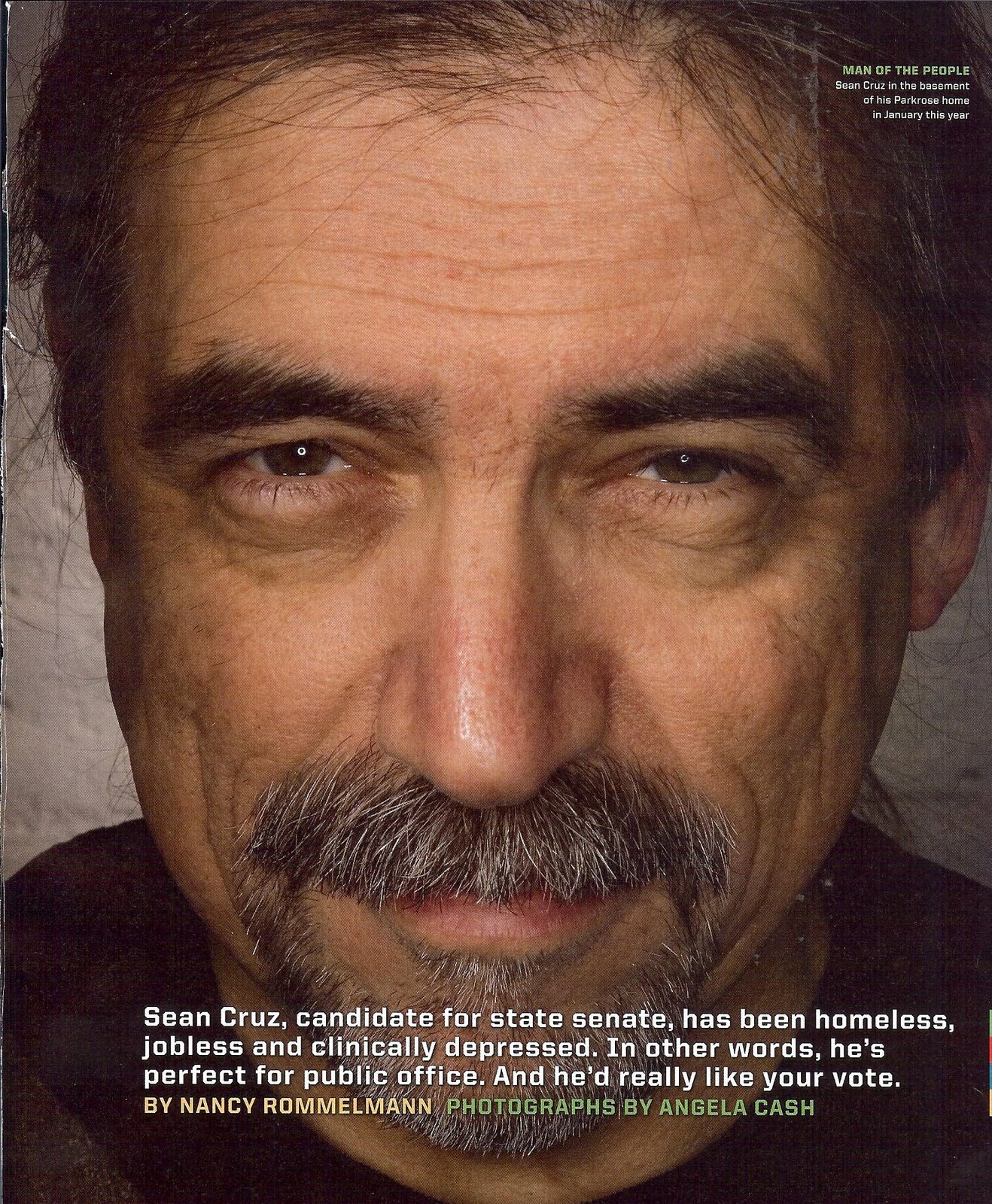
By Sean Cruz
Portland, Oregon--The Oregonian’s recent editorial, “A race run for pols, not for voters”, made several important points about elections in general and about what Oregonians want in particular, points that few would argue with:
1. “Challengers always want more debates; incumbents tend to want fewer.”
2. “Voters benefit from seeing and hearing as much as they can from the people who ask to represent them in (Salem)….”
3. “What Oregonians hunger for is the authentic voice of a person with a passion to serve them. They want their candidates to demonstrate an understanding of the issues and reasonable approaches to addressing them…What Oregonians hope for is some evidence of original thought and real humanity.”
Oregonians also want to have a choice between qualified candidates. They want to know their options so that they can choose among them.
Across the nation, voters are clamoring for CHANGE, in capital letters! Even the Republicans are trying to climb aboard the change wagon.
But across the City, Portland voters will soon mark their ballots in a process that is more an acknowledgement that the system itself trumps the body politic than it is an actual election.
Most of the races were decided back before May 20.
In Oregon, the legislature maintains an approval rating of only 30%, setting the stage for change, for new voices to emerge, but many Portland legislative races were settled as long as a year ago, long before the March filing deadline.
We approach the November election with a host of single-candidate races, just like in the former Soviet Union, like present-day North Korea, not much to be proud of in the democracy department.
Those incumbent candidates that had the power to restrict debate and candidate forum opportunities did so, a strategy built on running out the clock for the May 20 primary. There was little public discussion in legislative races.
The contests for Senate District 23 in NE and SE Portland (and its two House Districts, 45 and 46) offer a prime case in point, with two open seats at stake:
There were no challengers, no contest, no debates and no campaigning at all for the HD 46 spot, a race decided back at the March 15 filing deadline. No prospect of change, or for a new voice to break in there.
However, with well-qualified candidates competing for both its Senate and House open seats, HD 45 offered real opportunity for an exciting public process and a thorough discussion of the issues that matter.
The Oregonian editorial board found that both Senate candidates, Sean Cruz and Jackie Dingfelder, were qualified for the job, yet there were no debates. The first and only time that the two Senate District 23 candidates were on a platform together was on May 3rd, after the ballots were already in the mail, and that event occurred in HD 46, where there were no House candidates, instead of in HD 45, where there were.
The Oregonian editorial board endorsed the marvelously-gifted Cyreena Boston for HD 45, and found much to like about Michael Dembrow, her main challenger, but there were no debates held in the district.
The entire primary season passed without a single opportunity for the voters of House District 45 to see and hear together the candidates who would represent them in the Oregon Senate for the next four years, and in the Oregon House for the next two.
You would think that the voters would be upset about this….
There was no opportunity for the voters of Senate District 23 and House Districts 45 and 46 to hear where either the candidates or the incumbents stood on the issues, standing on a platform at the same time, with an opportunity for audience participation, because those events did not occur.
There was no actual public process in these key races. Instead, the candidates met privately and separately before representatives of a variety of special-interest organizations, focused entirely on their respective, private agendas.
The endorsements and special-interest cash flowed from those private meetings.
The political parties had no interest in providing candidate forums. The incumbents wouldn’t like that.
The normally-conscientious Oregon League of Women Voters overlooked the legislative races entirely, and the new, utterly inept Oregon League of Minority Voters could not locate these two races that actually featured minority candidates and the state’s largest concentrations of minorities (see Voter-Owned Democracy, Portland Style: “The Oregon League of Minority Voters and the Suppression of Opportunity,” coming soon).
A public platform would have forced the House District 46 incumbent, Ben Cannon, out of his house during the runup to the primaries.
Even though he was "running" unopposed, Representative Cannon would have had an important role in participating in the process of providing his constituents with an opportunity to hear all of the candidates for the seat that would represent them in the Senate.
But staging a debate in the district he represents would have worked to level the playing field among the candidates in both Senate District 23 and House District 45 races, where an all-out union-based effort to elect Jackie Dingfelder and Michael Dembrow was underway.
I intend to comment further on these and other issues, after having taken much of the summer off to give my readers a break, and to take some time for myself.
Over the summer, I learned how to install new floor and countertop tiles in my kitchen and bath, worked in my garden, walked my dog a whole bunch, and started playing Texas no-limit Hold-em poker online fairly regularly. I plan to sharpen my game up a bit and take a big bite out of one of those Las Vegas casinos some day.
More to come….
Future Voter-Owned Democracy, Portland-style topics:
1. AFSCME-gate, early insider endorsements, and how the unions locked up
2. The Oregon League of Minority Voters (OLMV) and the Suppression of Opportunity
3. Cruz vs Dingfelder—on Renaming Interstate Avenue and a related topic: The Revenge of the Avenistas
4. Cruz vs Dingfelder—for Barack or Hillary?
5. Cruz vs Dingfelder—on the Legislative pay and Capitol furnishings controversy
6. Cruz vs Dingfelder—on Veterans, the Oregon National Guard, and the wars in Iraq and Afghanistan
7. Cruz vs Dingfelder—on Immigration, race, color and ethnicity in Oregon
8. Predatory Patrol Towing—Portland’s #1 Predatory Patrol Towing Horror Story continues
and more….
Showing posts with label incumbents can be outvoted. Show all posts
Showing posts with label incumbents can be outvoted. Show all posts
Sunday, September 14, 2008


Tuesday, May 27, 2008
Sleight of hand and East Portland legislative races
Portland, Oregon—
A full week since the May 20 party primaries capped their exercises in promotion-from-within, the four East Portland legislative races have yet to enter the realm of public discourse.
Most of the legislative incumbents coasted through the primaries without a whisper of competition.
Those days are going to come to an end, perhaps in this election cycle.
Every incumbent, no matter how secure they might be within their party framework, can be outvoted in the 2008 November general election for two basic reasons:
1. Candidates in the general election can compete for all of the voters.
2. The World Wide Web has reached the point of maturity where write-in campaigns are economically and strategically feasible, enabling candidates and voters to interact without any gatekeeper or other intermediary.
I intend to prove these points in Oregon State Senate District 23, but any incumbent is vulnerable.
There are other supporting reasons:
1. The Oregon Legislature’s approval rating is only 30%, even after the highly successful 2007 session.
2. Oregonians want to see election reform and campaign finance reform actually happen, not just get kicked to the next campaign season again.
3. Oregonians value real choices among real candidates, and I believe they are ready to step up and decide who the candidates will be on their own. This factor alone will turn the party primary process inside out.
4. Most party stalwarts (and elected officials) are still in the Stone Age in the use of technology. Younger generations of voters do not share that handicap. They have the networking and resource-accessing skills to engineer their own campaigns and their own successes.
There will be an electoral tsunami in America, and it will be led by the tech-savvy who manage to acquire competence in the office they are seeking.
Career politicians will have to adjust their skill sets, like, right now!
The primary “race” for Senate District 23 was more about insider sleight of hand than it was about issues, ideas and the district’s needs.
I’m planning a series of posts describing the behind-the-scene shenanigans that took place along the way, including the AFSCME-gate story that every voter in the district will really want to know about.
The Web will allow voters free access to all the information they need to make an informed choice in November.
There are a lot of people who aren’t going to like hearing this; fortunately, most of them live outside of my district, Senate District 23.
--Sean Cruz, May 27, 2008
=============
The Oregonian Editorial Board on Senate District 23:
“(Sean) Cruz…knows the issues well…”
“Sean Cruz, who has served as (Senator) Gordly's legislative aide and chief of staff for the past five years…is qualified for the job. He knows the issues that are important in the district, and he certainly knows how things get done in the Legislature. Most notably, he persuaded Gordly to push legislation, called ‘Aaron's Law,’ that gives families tools to punish parents for the crime of child abduction. “
===========================
www.BlogoliticalSean.blogspot.com
A full week since the May 20 party primaries capped their exercises in promotion-from-within, the four East Portland legislative races have yet to enter the realm of public discourse.
Most of the legislative incumbents coasted through the primaries without a whisper of competition.
Those days are going to come to an end, perhaps in this election cycle.
Every incumbent, no matter how secure they might be within their party framework, can be outvoted in the 2008 November general election for two basic reasons:
1. Candidates in the general election can compete for all of the voters.
2. The World Wide Web has reached the point of maturity where write-in campaigns are economically and strategically feasible, enabling candidates and voters to interact without any gatekeeper or other intermediary.
I intend to prove these points in Oregon State Senate District 23, but any incumbent is vulnerable.
There are other supporting reasons:
1. The Oregon Legislature’s approval rating is only 30%, even after the highly successful 2007 session.
2. Oregonians want to see election reform and campaign finance reform actually happen, not just get kicked to the next campaign season again.
3. Oregonians value real choices among real candidates, and I believe they are ready to step up and decide who the candidates will be on their own. This factor alone will turn the party primary process inside out.
4. Most party stalwarts (and elected officials) are still in the Stone Age in the use of technology. Younger generations of voters do not share that handicap. They have the networking and resource-accessing skills to engineer their own campaigns and their own successes.
There will be an electoral tsunami in America, and it will be led by the tech-savvy who manage to acquire competence in the office they are seeking.
Career politicians will have to adjust their skill sets, like, right now!
The primary “race” for Senate District 23 was more about insider sleight of hand than it was about issues, ideas and the district’s needs.
I’m planning a series of posts describing the behind-the-scene shenanigans that took place along the way, including the AFSCME-gate story that every voter in the district will really want to know about.
The Web will allow voters free access to all the information they need to make an informed choice in November.
There are a lot of people who aren’t going to like hearing this; fortunately, most of them live outside of my district, Senate District 23.
--Sean Cruz, May 27, 2008
=============
The Oregonian Editorial Board on Senate District 23:
“(Sean) Cruz…knows the issues well…”
“Sean Cruz, who has served as (Senator) Gordly's legislative aide and chief of staff for the past five years…is qualified for the job. He knows the issues that are important in the district, and he certainly knows how things get done in the Legislature. Most notably, he persuaded Gordly to push legislation, called ‘Aaron's Law,’ that gives families tools to punish parents for the crime of child abduction. “
===========================
www.BlogoliticalSean.blogspot.com
Sunday, May 25, 2008
Veterans Memorial Day and the race for Oregon Senate District 23
Portland, Oregon—
I’m going to cut right to the chase: The fact is that the American people largely accept the war casualty rates in Iraq and Afghanistan.
They shrug it off, complain a little, but at the end of the day have something else on their minds; like, for example, ethanol, and they shrug it off.
These wars are happening to Other People, Elsewhere, On TV.
Some offer Moments of Silence now and then; but the People are already silent, I say, and moments of silence are nothing more than that, opportunities to be silent together and reinforce our devotion to silence.
The nation’s college campuses are hotbeds of inaction and rest, if not outright privilege. You’d never know there was a war on, hanging out on campus.
This is how wars drag on for ten or thirty years or more, even in democratic societies. It starts with an acceptable casualty rate, which is related to the nation’s sense of who is, well, expendable.
If the nation is settled on losing only the expendable, then business and politics can proceed as usual, like in the recent Oregon primary races.
Here we are on Memorial Day, a holiday marked by many with profligate displays of high-octane fuel-burning, and by many millions of Americans who spend the weekend setting tanks of fossil fuels on fir, mile by mile over the asphalt roads and highways.
Many complain about the cost of gasoline and diesel fuel; can’t seem to connect the price spike with the fact that if you invade an oil-producing nation on the other side of the world, you should expect the price to go up.
Throughout the entire primary period, there was no public discussion of veterans issues or the costs of the wars. I brought the subject up twice in the Williamette Week interview, also in the Oregonian and Matt Davis (Portland Mercury) interviews.
The Skanner didn’t even have interviews, figure that one out. Too busy putting out a newspaper once a week, lots of cutting and pasting from the AP wire involved.
None of the local Portland races ever got out of the bubble, the war nonexistent even in its impact on local budgets and resources, apparently.
The candidates for federal offices alone recognized the wars exist, offering challenges and counterchallenges on what to do about the wars.
No one pointed out that whatever direction the troops move in, the move will result in loss of life. Whatever you do, people will die—our people, our loved ones.
There is no way that someone standing here in Oregon can know how to make that happen.
Every path from Iraq leads through death and destruction, which is why it is so important not to launch an invasion in the first place, and so vital for the People and their elected officials to stop being so damned silent.
Our injured will come home to a long-overwhelmed VA system and politicians with ethanol on their minds.
In a truly democratic society, every single elected official who had a piece of moving our military and their families into endless hell ought to have been tossed out of office more than four years ago. None merit re-appointment or re-election.
Those who were in office and let it happen on their watch ought to have been put on probation at minimum, some already cashiered by now.
Senate District 23 and House Districts 45 and 46, on this day, are much like the rest of the nation: The wars are happening to Other People, Elsewhere, On TV.
The Ethanol Mafia is celebrating the Senate District 23 primary victory of my opponent, a little too early in my book.
My guess is that the wars in Iraq and Afghanistan will still be ruining the lives of our loved ones in November, and for we military families, alone bearing the burden, veterans issues will trump any other interest.
I am calling for the appointment of a new, permanent Senate Veterans Affairs Committee, and I will—with your help--serve there, starting in January, 2009.
This Senate committee will work in a nonpartisan way, alongside the overburdened House Veterans Affairs Committee and the Governor’s Office, to address the critical needs of our troops, our veterans and their families.
No more will there be a day in the Oregon Senate when the flags are at half staff outside of the Capitol and yet there is no honoring of the fallen in either House or Senate chamber, and that’s just for starters.
We have more than five months to muster, to organize a write-in campaign, and deliver a historic victory in the November general election.
This change will be immediate, C.O.D.
--Sean Cruz, May 25, 2008
=======================
The Oregonian Editorial Board on Senate District 23:
“Cruz…knows the issues well…”
“Sean Cruz, who has served as (Senator) Gordly's legislative aide and chief of staff for the past five years…is qualified for the job. He knows the issues that are important in the district, and he certainly knows how things get done in the Legislature. Most notably, he persuaded Gordly to push legislation, called ‘Aaron's Law,’ that gives families tools to punish parents for the crime of child abduction. “
===========================
I’m going to cut right to the chase: The fact is that the American people largely accept the war casualty rates in Iraq and Afghanistan.
They shrug it off, complain a little, but at the end of the day have something else on their minds; like, for example, ethanol, and they shrug it off.
These wars are happening to Other People, Elsewhere, On TV.
Some offer Moments of Silence now and then; but the People are already silent, I say, and moments of silence are nothing more than that, opportunities to be silent together and reinforce our devotion to silence.
The nation’s college campuses are hotbeds of inaction and rest, if not outright privilege. You’d never know there was a war on, hanging out on campus.
This is how wars drag on for ten or thirty years or more, even in democratic societies. It starts with an acceptable casualty rate, which is related to the nation’s sense of who is, well, expendable.
If the nation is settled on losing only the expendable, then business and politics can proceed as usual, like in the recent Oregon primary races.
Here we are on Memorial Day, a holiday marked by many with profligate displays of high-octane fuel-burning, and by many millions of Americans who spend the weekend setting tanks of fossil fuels on fir, mile by mile over the asphalt roads and highways.
Many complain about the cost of gasoline and diesel fuel; can’t seem to connect the price spike with the fact that if you invade an oil-producing nation on the other side of the world, you should expect the price to go up.
Throughout the entire primary period, there was no public discussion of veterans issues or the costs of the wars. I brought the subject up twice in the Williamette Week interview, also in the Oregonian and Matt Davis (Portland Mercury) interviews.
The Skanner didn’t even have interviews, figure that one out. Too busy putting out a newspaper once a week, lots of cutting and pasting from the AP wire involved.
None of the local Portland races ever got out of the bubble, the war nonexistent even in its impact on local budgets and resources, apparently.
The candidates for federal offices alone recognized the wars exist, offering challenges and counterchallenges on what to do about the wars.
No one pointed out that whatever direction the troops move in, the move will result in loss of life. Whatever you do, people will die—our people, our loved ones.
There is no way that someone standing here in Oregon can know how to make that happen.
Every path from Iraq leads through death and destruction, which is why it is so important not to launch an invasion in the first place, and so vital for the People and their elected officials to stop being so damned silent.
Our injured will come home to a long-overwhelmed VA system and politicians with ethanol on their minds.
In a truly democratic society, every single elected official who had a piece of moving our military and their families into endless hell ought to have been tossed out of office more than four years ago. None merit re-appointment or re-election.
Those who were in office and let it happen on their watch ought to have been put on probation at minimum, some already cashiered by now.
Senate District 23 and House Districts 45 and 46, on this day, are much like the rest of the nation: The wars are happening to Other People, Elsewhere, On TV.
The Ethanol Mafia is celebrating the Senate District 23 primary victory of my opponent, a little too early in my book.
My guess is that the wars in Iraq and Afghanistan will still be ruining the lives of our loved ones in November, and for we military families, alone bearing the burden, veterans issues will trump any other interest.
I am calling for the appointment of a new, permanent Senate Veterans Affairs Committee, and I will—with your help--serve there, starting in January, 2009.
This Senate committee will work in a nonpartisan way, alongside the overburdened House Veterans Affairs Committee and the Governor’s Office, to address the critical needs of our troops, our veterans and their families.
No more will there be a day in the Oregon Senate when the flags are at half staff outside of the Capitol and yet there is no honoring of the fallen in either House or Senate chamber, and that’s just for starters.
We have more than five months to muster, to organize a write-in campaign, and deliver a historic victory in the November general election.
This change will be immediate, C.O.D.
--Sean Cruz, May 25, 2008
=======================
The Oregonian Editorial Board on Senate District 23:
“Cruz…knows the issues well…”
“Sean Cruz, who has served as (Senator) Gordly's legislative aide and chief of staff for the past five years…is qualified for the job. He knows the issues that are important in the district, and he certainly knows how things get done in the Legislature. Most notably, he persuaded Gordly to push legislation, called ‘Aaron's Law,’ that gives families tools to punish parents for the crime of child abduction. “
===========================
Friday, May 23, 2008
The race for Senate District 23 is still unsettled
Portland, Oregon—
I have received several email communications in the past few days suggesting that my write-in campaign is about being a sore loser, but that’s not the case at all.
I stated from the beginning that my campaign to win the Senate District 23 seat representing NE and SE Portland neighborhoods and the City of Maywood Park would be unconventional and web-based.
I didn’t get much more specific about my plans than that, even with my campaign steering committee, but I was thinking about ways in which technology was evolving, moving opportunity in ways the party structure and other traditional gatekeepers could not control.
I disclosed the post-primary write-in phase of the campaign to just a few people, and to them only a couple of weeks before May 20.
My premise is that, in the wired world, citizens can overcome the advantages career politicians have at every point in the process, and reach directly to the “Write in” blank that is printed in every race on every ballot.
One of the chief factors causing undervoting and voter lethargy (both of which help keep incumbents in power) is single-candidate “races.”
They have ballots like that in Cuba and North Korea, too, and in the old Soviet Union.
“Totalitarian systems depend on a monopoly of information and force (and political opportunity—sc).” –Thomas L. Friedman, The World is Flat
The gatekeepers want to limit the voters’ choices in Senate District 23 to a single name, and I say that is no choice at all.
The cost of getting a name out there has been the single most important barrier to effective write-in campaigns, but that obstacle is falling like the Berlin Wall.
Oregon is possibly the best place in the nation to test out my theory, with its mail-in ballots that are like an open book test, and an electorate largely unaffiliated with any political party, increasingly computer literate and comfortable with searching out information individually.
This is really scary to the party functionaries, the special interests and the lobbyists, bent on promoting from within.
As a resident of Senate District 23 and House District 45, which are both getting a new legislator in 2009, I am offended that there was no public debate or forum throughout the entire primary period that addressed the voters’ choices.
The fact is, incumbents don’t want debates or forums with challengers. The more they can ride out the election with name familiarity alone, the less likely an upset will ensue.
Here we are, four days after the election, and there has still been nothing in the media, no analysis at all, about any of the contested East side legislative races.
We had months of buffoonery in the Portland City races, much of it fueled by public dollars, but no thoughtful discourse on the election of two state senators and two state representatives on the East side.
I styled the Primary stage of my campaign after Muhammed Ali’s famous Rope-a-Dope strategy, which won him the Heavyweight championship over a heavily-favored George Foreman in his prime.
I took a fearful beating from the Dingfelder-Gainer machine, an opponent with the relentless determination of the Terminator's nemesis, but I knew it was coming, and I knew it would end. Eventually, we would get to the issues that matter to the voters in Senate District 23.
Technology makes this possible, its low cost and its infinite reach.
Phase II, post-Primary, is also styled after Muhammed Ali: “Float like a butterfly, sting like a bee,” all the way to the November General Election.
I have a great deal of information to share with the voters over the coming months, lots to talk about, lots of light to shed.
None of the several people who wrote in complaining about Phase II is a resident of Senate District 23, which brings us to an interesting point for further discussion: most of the Dingfelder supporters and endorsers in the primary weren’t residents of the district either.
What unfolded was a by-the-book machine-politics campaign led by a small group of insiders, some with motives that have nothing to do with the district, most of whom live elsewhere. Plenty to talk about here, too.
I intend to demonstrate that a write-in campaign is feasible in Oregon. I may or may not be successful in my race for Senate District 23. We won’t have the answer to that until November, but if my race inspires other citizens to step up and take on the machine, then it will have been worth the effort.
--Sean Cruz, May 23, 2008
========
The Oregonian Editorial Board on Senate District 23:
“Cruz…knows the issues well…”
“Sean Cruz, who has served as (Senator) Gordly's legislative aide and chief of staff for the past five years…is qualified for the job. He knows the issues that are important in the district, and he certainly knows how things get done in the Legislature. Most notably, he persuaded Gordly to push legislation, called ‘Aaron's Law,’ that gives families tools to punish parents for the crime of child abduction. “
I have received several email communications in the past few days suggesting that my write-in campaign is about being a sore loser, but that’s not the case at all.
I stated from the beginning that my campaign to win the Senate District 23 seat representing NE and SE Portland neighborhoods and the City of Maywood Park would be unconventional and web-based.
I didn’t get much more specific about my plans than that, even with my campaign steering committee, but I was thinking about ways in which technology was evolving, moving opportunity in ways the party structure and other traditional gatekeepers could not control.
I disclosed the post-primary write-in phase of the campaign to just a few people, and to them only a couple of weeks before May 20.
My premise is that, in the wired world, citizens can overcome the advantages career politicians have at every point in the process, and reach directly to the “Write in” blank that is printed in every race on every ballot.
One of the chief factors causing undervoting and voter lethargy (both of which help keep incumbents in power) is single-candidate “races.”
They have ballots like that in Cuba and North Korea, too, and in the old Soviet Union.
“Totalitarian systems depend on a monopoly of information and force (and political opportunity—sc).” –Thomas L. Friedman, The World is Flat
The gatekeepers want to limit the voters’ choices in Senate District 23 to a single name, and I say that is no choice at all.
The cost of getting a name out there has been the single most important barrier to effective write-in campaigns, but that obstacle is falling like the Berlin Wall.
Oregon is possibly the best place in the nation to test out my theory, with its mail-in ballots that are like an open book test, and an electorate largely unaffiliated with any political party, increasingly computer literate and comfortable with searching out information individually.
This is really scary to the party functionaries, the special interests and the lobbyists, bent on promoting from within.
As a resident of Senate District 23 and House District 45, which are both getting a new legislator in 2009, I am offended that there was no public debate or forum throughout the entire primary period that addressed the voters’ choices.
The fact is, incumbents don’t want debates or forums with challengers. The more they can ride out the election with name familiarity alone, the less likely an upset will ensue.
Here we are, four days after the election, and there has still been nothing in the media, no analysis at all, about any of the contested East side legislative races.
We had months of buffoonery in the Portland City races, much of it fueled by public dollars, but no thoughtful discourse on the election of two state senators and two state representatives on the East side.
I styled the Primary stage of my campaign after Muhammed Ali’s famous Rope-a-Dope strategy, which won him the Heavyweight championship over a heavily-favored George Foreman in his prime.
I took a fearful beating from the Dingfelder-Gainer machine, an opponent with the relentless determination of the Terminator's nemesis, but I knew it was coming, and I knew it would end. Eventually, we would get to the issues that matter to the voters in Senate District 23.
Technology makes this possible, its low cost and its infinite reach.
Phase II, post-Primary, is also styled after Muhammed Ali: “Float like a butterfly, sting like a bee,” all the way to the November General Election.
I have a great deal of information to share with the voters over the coming months, lots to talk about, lots of light to shed.
None of the several people who wrote in complaining about Phase II is a resident of Senate District 23, which brings us to an interesting point for further discussion: most of the Dingfelder supporters and endorsers in the primary weren’t residents of the district either.
What unfolded was a by-the-book machine-politics campaign led by a small group of insiders, some with motives that have nothing to do with the district, most of whom live elsewhere. Plenty to talk about here, too.
I intend to demonstrate that a write-in campaign is feasible in Oregon. I may or may not be successful in my race for Senate District 23. We won’t have the answer to that until November, but if my race inspires other citizens to step up and take on the machine, then it will have been worth the effort.
--Sean Cruz, May 23, 2008
========
The Oregonian Editorial Board on Senate District 23:
“Cruz…knows the issues well…”
“Sean Cruz, who has served as (Senator) Gordly's legislative aide and chief of staff for the past five years…is qualified for the job. He knows the issues that are important in the district, and he certainly knows how things get done in the Legislature. Most notably, he persuaded Gordly to push legislation, called ‘Aaron's Law,’ that gives families tools to punish parents for the crime of child abduction. “
Wednesday, May 21, 2008
When candidates can't lose, we all do
Portland, Oregon--The Oregonian printed an article from the Washington Post on May 5, titled “When candidates can’t lose, we all do,” that explored the lack of competition in Congressional races.
The piece was written by Bruce Reed, President of the Democratic Leadership Council and Marc Dunkelman, the Council’s Vice President for Strategy and Communication.
The points the authors make apply directly to the Oregon legislature and the current campaign season, witness the following excerpts with substitutions:
“Competition and democracy go hand in hand…But real competition is still a rare commodity in the (Oregon legislature).”
“The relative comfort that most members of (the Oregon legislature) enjoy…diminishes the power voters can exert over the agenda in (Salem). When members can’t lose, voters do—because it takes the pressure off (the legislature) to get the job done.”
“Besides letting members off the hook for failing to do the people’s business, noncompetitive districts also suppress voter participation. Elections where the outcome is assumed from the start receive less media attention. Candidates do not feel as compelled to make their cases to the public. And voters aren’t stupid: When the outcome is essentially predetermined, there’s less reason to cast a ballot.”
“With (Oregonians) disillusioned by (Salem’s) seeming inability to move beyond the partisan divide that has poisoned the spirit of compromise, reducing the influence of special interests may be only part of the solution. If we want more (Oregonians) to participate in their democracy, we should make sure more of them have an opportunity to affect the outcome of the campaign for their local seat (in the Oregon Senate).”
The May 20 Democratic Primary drew record numbers of voters, but not as a result of any of the legislative races, of which most were uncontested.
Many insiders and the mainstream media regarded Senate District 23 as such a foregone conclusion that no real opportunities arose for the candidates to engage in public debates or forums, even though there were many clear differences in priorities between the candidates and important issues were on the table.
The public has no right to criticize a legislature that is selected under these conditions, and no reason to expect much to change.
“Meet the new boss. Same as the old boss.”
Fortunately, for the voters of Senate District 23, there will still be an opportunity to make a choice between qualified candidates in November.
Technology is making hierarchies flatter and gatekeepers less effective at controlling the process.
They will not loosen their collective grip willingly.
When the general election ballots arrive, voters will have a choice in many races of either checking the box for the sole candidate (like in the former Soviet Union), or they may exercise their right to write in the name of the candidate of their choice.
Between now and then, I will continue to post my comments on the issues and look for opportunities to speak to voters, especially about the issues that never got an airing in the primary process.
Here’s one: both candidates for Senate District 23 are strong supporters of investments in education, but only Sean Cruz has announced his support for the multimillion dollar bond measure that Portland Community College will put before the voters in the fall.
This is a crucial matter for Senate District 23, its PCC SE campus and the neighborhoods it serves, but the subject never came up.
Many insiders had their minds made up on the race a year ago, when there was only one candidate. Many were already pledged to support her campaign.
They had no incentive to promote speaking opportunities that would offer a platform for an opponent.
Most weren’t residents of Senate District 23 either, and the special interest endorsement people were deaf to the issues specific to the district.
The World Wide Web can fix some of that, and over time it will fix much more.
Meanwhile, the campaign will move into Write-in mode.
More comments on the way.
--Sean Cruz
The piece was written by Bruce Reed, President of the Democratic Leadership Council and Marc Dunkelman, the Council’s Vice President for Strategy and Communication.
The points the authors make apply directly to the Oregon legislature and the current campaign season, witness the following excerpts with substitutions:
“Competition and democracy go hand in hand…But real competition is still a rare commodity in the (Oregon legislature).”
“The relative comfort that most members of (the Oregon legislature) enjoy…diminishes the power voters can exert over the agenda in (Salem). When members can’t lose, voters do—because it takes the pressure off (the legislature) to get the job done.”
“Besides letting members off the hook for failing to do the people’s business, noncompetitive districts also suppress voter participation. Elections where the outcome is assumed from the start receive less media attention. Candidates do not feel as compelled to make their cases to the public. And voters aren’t stupid: When the outcome is essentially predetermined, there’s less reason to cast a ballot.”
“With (Oregonians) disillusioned by (Salem’s) seeming inability to move beyond the partisan divide that has poisoned the spirit of compromise, reducing the influence of special interests may be only part of the solution. If we want more (Oregonians) to participate in their democracy, we should make sure more of them have an opportunity to affect the outcome of the campaign for their local seat (in the Oregon Senate).”
The May 20 Democratic Primary drew record numbers of voters, but not as a result of any of the legislative races, of which most were uncontested.
Many insiders and the mainstream media regarded Senate District 23 as such a foregone conclusion that no real opportunities arose for the candidates to engage in public debates or forums, even though there were many clear differences in priorities between the candidates and important issues were on the table.
The public has no right to criticize a legislature that is selected under these conditions, and no reason to expect much to change.
“Meet the new boss. Same as the old boss.”
Fortunately, for the voters of Senate District 23, there will still be an opportunity to make a choice between qualified candidates in November.
Technology is making hierarchies flatter and gatekeepers less effective at controlling the process.
They will not loosen their collective grip willingly.
When the general election ballots arrive, voters will have a choice in many races of either checking the box for the sole candidate (like in the former Soviet Union), or they may exercise their right to write in the name of the candidate of their choice.
Between now and then, I will continue to post my comments on the issues and look for opportunities to speak to voters, especially about the issues that never got an airing in the primary process.
Here’s one: both candidates for Senate District 23 are strong supporters of investments in education, but only Sean Cruz has announced his support for the multimillion dollar bond measure that Portland Community College will put before the voters in the fall.
This is a crucial matter for Senate District 23, its PCC SE campus and the neighborhoods it serves, but the subject never came up.
Many insiders had their minds made up on the race a year ago, when there was only one candidate. Many were already pledged to support her campaign.
They had no incentive to promote speaking opportunities that would offer a platform for an opponent.
Most weren’t residents of Senate District 23 either, and the special interest endorsement people were deaf to the issues specific to the district.
The World Wide Web can fix some of that, and over time it will fix much more.
Meanwhile, the campaign will move into Write-in mode.
More comments on the way.
--Sean Cruz
Subscribe to:
Posts (Atom)

 Posts
Posts